IDF Warns Deadly Settler Attack Could Trigger Palestinian Retaliation in West Bank
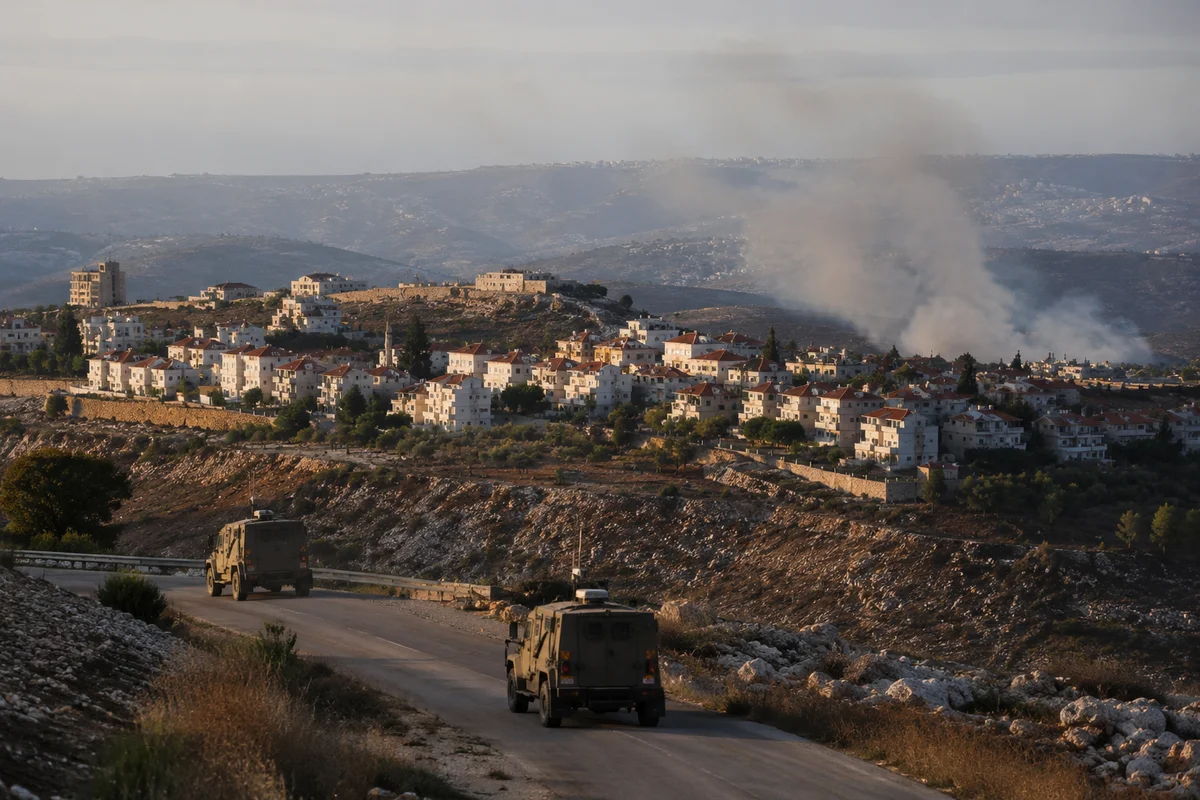
Jerusalem, August 31, 2026: Senior Israeli military officials have warned that escalating settler violence against Palestinians in the occupied West Bank could trigger armed Palestinian retaliation and a wider security crisis, according to a report by Haaretz.
At the heart of the warning is a scenario Israeli officials consider a worst case: a major settler attack that leaves multiple Palestinians dead or wounded, followed by retaliatory strikes against Israeli settlers or other Israeli targets. The Israel Defense Forces fear such an incident could ignite a cycle of violence that spreads across the West Bank and proves difficult to contain, Haaretz reported.
That doesn't mean officials believe a mass-casualty attack is imminent, or that large-scale Palestinian retaliation has already started. What they're describing instead is a rising risk. Continued settler violence, they warn, makes a serious escalation more likely with each passing incident. If a particularly deadly attack were to kill or wound a significant number of Palestinians, the fear is that armed Palestinians would respond by targeting settlers or other Israeli interests, drawing in further Israeli military action and setting off a broader spiral. Within Israel's security establishment, this chain of events is reportedly being treated as a genuine worst-case possibility.
The warning builds on concerns Maj. Gen. Avi Bluth, commander of the IDF's Central Command, has raised before. Bluth has said attacks by Jewish extremists could help ignite a wider Palestinian uprising. That view has taken hold more broadly among Israeli security officials, who now see violent settler activity less as a fringe problem and more as a security threat in its own right — one capable of provoking Palestinian retaliation and destabilizing the territory further. The current assessment fits that pattern: settler violence isn't just a symptom of instability, officials fear, but could become one of its triggers.
It's a concern with precedent. The assessment recalls the 2015 Duma arson attack, when Jewish extremists firebombed the home of a Palestinian family in the West Bank village of Duma that July. Saad Dawabsheh, his wife Riham and their 18-month-old son Ali were killed. Their other son, Ahmad, survived after suffering severe burns. The attack became one of the starkest examples of extremist Jewish violence in the West Bank, and it was followed at the time by fears of revenge attacks. According to Haaretz, Israeli military officials worry that another attack causing multiple Palestinian casualties could trigger a similar chain reaction today.
The figures underscore the scale of the violence. Israel's Kan public broadcaster, in figures cited by The Times of Israel, recorded 660 incidents classified as Jewish "nationalistic crime" in the first six months of 2026 — a 63% jump from the 405 incidents logged over the same period in 2025. Attacks on Israeli security forces rose too, up 50%, with 45 such incidents in the first half of the year.
Palestinian casualties climbed alongside them. The same figures show 140 Palestinians wounded and six killed in the first half of 2026, compared with 82 wounded and no deaths during the same period a year earlier. It's worth noting these numbers come specifically from incidents Israeli authorities classify as nationalistic crime, and shouldn't be conflated with the broader tally kept by the United Nations.
That UN tally paints an even wider picture. The UN Office for the Coordination of Humanitarian Affairs has documented more than 1,380 settler-related incidents across the West Bank since the start of 2026, through the end of July — touching more than 250 Palestinian communities at a pace of roughly 6.6 incidents a day. Around 900 Palestinians were injured over that stretch, and more than 2,300 were displaced as a result of settler attacks and the access restrictions that came with them. OCHA's count casts a wider net than Israel's nationalistic-crime figures, capturing any incident involving Palestinian casualties, property damage, or both.
The violence itself has taken many forms — physical assaults, stone-throwing, live gunfire, arson, and damage to homes, vehicles, farmland and other property. In one July reporting period alone, OCHA logged at least 40 such incidents, with at least 16 Palestinians injured. Homes, vehicles and livelihoods bore the brunt of it, and hundreds of olive trees were damaged or destroyed in the process. OCHA has also flagged a recurring pattern: Palestinian families forced out of their homes after sustained settler intimidation, attacks and restrictions on movement.
All of this has sharpened long-running questions about enforcement. Israeli security officials, along with critics of the government, have asked whether authorities are doing enough to stop attacks before they happen and hold perpetrators accountable afterward. That said, the reporting doesn't support the sweeping claim that arrests are near zero across the board — the more accurate picture is one of persistent concern over whether enforcement is keeping pace with the scale of the violence. For the IDF, that gap matters. Officials worry that attacks going unchecked could deepen Palestinian anger and, in turn, raise the odds of retaliation.
There's also a political backdrop to consider. Israel heads to the polls on October 27, 2026, and Prime Minister Benjamin Netanyahu's coalition includes far-right ministers such as Bezalel Smotrich and Itamar Ben-Gvir — both prominent backers of the settlement movement and of tighter Israeli control over the West Bank. How the government handles settler violence has become tangled up in that larger political fight over settlements and security policy, even as military officials keep pointing to the security stakes of leaving extremist violence unchecked.
What sets this warning apart is where it's coming from — not outside critics, but senior figures inside Israel's own military. The IDF isn't claiming an attack is about to happen, or that Palestinian retaliation is already underway. What officials are laying out is a chain they fear could take shape: a deadly settler attack, Palestinian casualties, armed retaliation, an Israeli military response, and an escalation that spreads well beyond wherever it started.
The West Bank was already under strain before this warning surfaced — military operations, militant attacks, settlement expansion, movement restrictions and settler violence all overlapping at once. UN reporting shows settler-related incidents continuing to hit Palestinian communities throughout 2026, with injuries, destroyed property and displacement showing up across multiple governorates. What the IDF is flagging now is the possibility that this pattern tips into something harder to walk back, if the wrong incident happens at the wrong moment.
For now, though, that's exactly what it remains: a warning about what could happen, not a forecast that it will.
Latest News
- BJP’s ‘Dimaagi Naxal’ Campaign Draws Fire Over Violent Film Imagery
- Meta, States in Settlement Talks Over Teen Safety Trial
- BJP, Meta and India’s Growing Power Over Online Content
- USCIRF Seeks Sanctions on RSS Ahead of Mohan Bhagwat’s US Visit
- Humanoid Robots Could Patrol U.S. Southern Border
- Ukraine Corruption Concerns Put Pressure on EU Accession
- Hefner Contacted FBI Over Epstein in 2005, Lawsuit Says
- Five Shot Near Virginia State University Dorms; One Critical
- South Korea’s Lee Calls for North Korea Peace Talks
- Cristiano Ronaldo Marries Georgina Rodriguez in Portugal