Ukraine's Corruption Reckoning Complicates, But Doesn't Derail, Its EU Bid
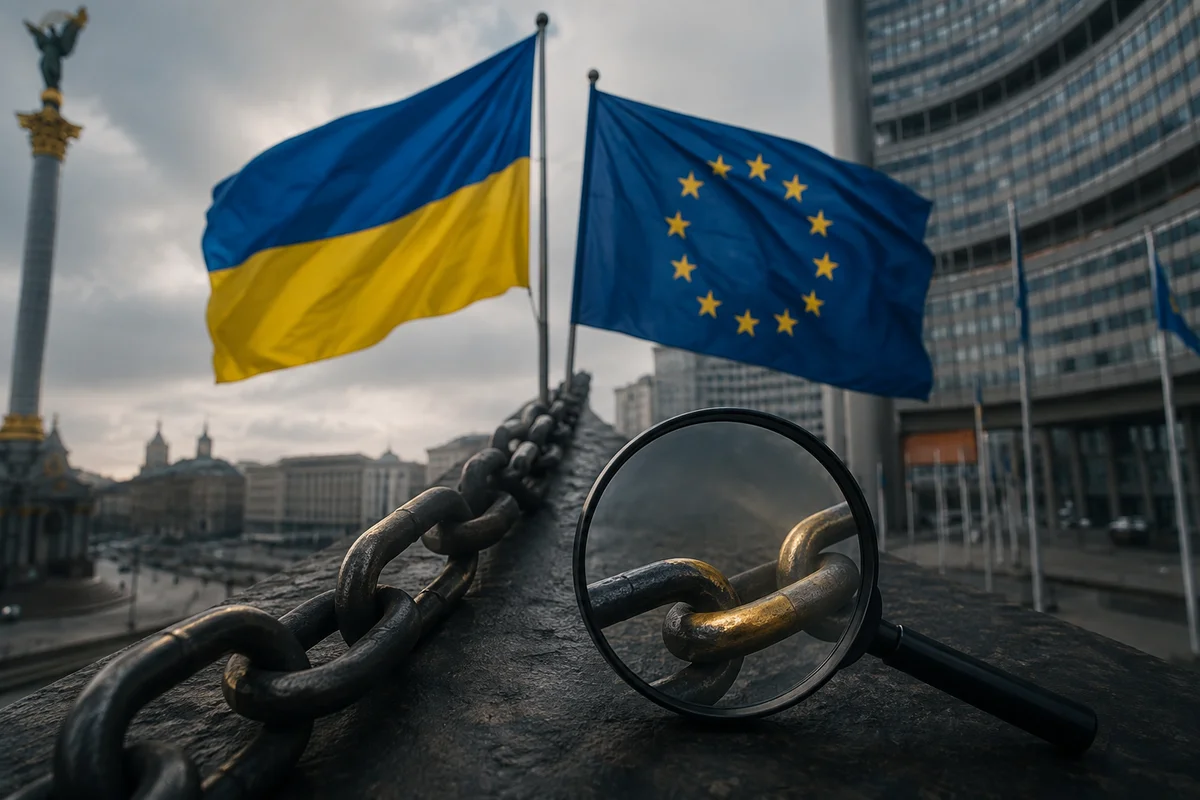
A series of corruption investigations involving figures from President Volodymyr Zelenskyy's former inner circle is putting renewed pressure on Kyiv's credibility with European partners, even as Ukraine's formal path toward European Union membership continues to move forward.
A commentary published August 15 by Germany's Berliner Zeitung argues that the allegations, combined with delays in delivering on promised reforms, are deepening doubts about the pace and effectiveness of Ukraine's anti-corruption efforts. The piece is an editorial analysis, not an official EU assessment. But similar concerns have come from EU Enlargement Commissioner Marta Kos herself, who said in February that trust between Ukraine and EU member states had not been fully restored after the 2025 dispute over anti-corruption agencies.
Alongside that debate, though, the official record shows accession talks moving forward. The bloc opened its first negotiating cluster with Ukraine, covering fundamental areas such as rule of law, democratic institutions and public administration, on June 15, 2026. A second cluster, on external relations, followed on July 14. Brussels has not paused or abandoned Ukraine's membership bid, but the pace of the process remains tied to progress on reforms and the implementation of EU requirements.
A case that reached the president's former chief of staff
One of the most politically significant cases involves Andriy Yermak, the former head of Ukraine's Presidential Office and a once-powerful figure in Zelenskyy's inner circle.
On May 11, Ukraine's National Anti-Corruption Bureau (NABU) and the Specialised Anti-Corruption Prosecutor's Office (SAPO) notified Yermak of suspicion in a money-laundering case tied to a luxury construction project near Kyiv. Investigators allege an organized group laundered roughly UAH 460 million through the development. Yermak has denied any wrongdoing.
Three days later, Ukraine's High Anti-Corruption Court placed him in pre-trial detention and set bail at UAH 140 million, along with travel restrictions and a prohibition on contacting other suspects. The bail was paid in full on May 18, and Yermak was released.
No conviction has been reported in the case. Yermak remains a suspect in an active criminal proceeding and is presumed innocent unless found guilty by a court.
According to Reuters, the case is part of a broader investigation known as Operation Midas, which has involved several figures in Zelenskyy's political and business orbit. Reuters also reported finding no evidence implicating Zelenskyy personally in the money-laundering case.
Defence procurement investigations widen the scope of scrutiny
The corruption investigations extend beyond the presidency's immediate circle. Ukraine's anti-corruption agencies have also pursued cases involving alleged irregularities in defence procurement and state institutions.
In an announcement on October 28, 2025, NABU and SAPO said officials at Ukraine's State Service of Special Communications and Information Protection had allegedly worked with private companies to manipulate the procurement of military drones. The agency had received UAH 30 billion for drone purchases following 2023 budget amendments. Investigators allege that 400 DJI Mavic 3 drones and 1,300 Autel Evo Max 4T drones were bought between May and September of that year at prices 70 to 90 percent above market rates, a markup that authorities say caused more than UAH 90 million in losses to the state. Officials say controlled companies were used to simulate competitive bidding and funnel the money, including abroad. Two government officials and two private-company representatives were notified of suspicion. NABU stressed that all four remain presumed innocent unless convicted.
A second case, announced December 11, 2025, involves more than UAH 102 million allegedly embezzled from funds meant to supply dynamic protection systems for Ukrainian armored vehicles. NABU and SAPO said a state enterprise purchased the equipment at nearly three times its actual cost, with shell companies allegedly used to obscure the scheme and move the resulting funds. Three people were notified of suspicion in that investigation.
As with the Yermak case, these remain allegations under active investigation, not judicial findings of guilt.
A reform roadmap tied to EU membership
Ukraine's anti-corruption commitments are formally linked to its accession process. On December 11, 2025, Kos and Ukrainian Deputy Prime Minister for European and Euro-Atlantic Integration Taras Kachka agreed on a ten-point reform plan targeting rule of law and anti-corruption measures, now commonly known as the Kachka-Kos plan.
Its provisions include changes to the Criminal Procedure Code, stronger independence and expanded jurisdiction for NABU and SAPO, reforms affecting high-risk corruption cases, changes to how the Prosecutor General and senior prosecutors are selected and dismissed, reform of the State Bureau of Investigation, judicial-integrity measures, a new national anti-corruption strategy and stronger safeguards against high-level corruption.
The plan's exact wording matters here. It calls for stronger institutional independence and protection from undue influence, including for NABU and SAPO. It does not say Ukrainian law-enforcement bodies will be removed from Zelenskyy's control, and describing it that way would go beyond what the official EU-Ukraine document actually says.
In February 2026, Kos said the ten points were meant to help rebuild trust with EU member states and that the Commission expected Ukraine to meet them.
Implementation lags behind the commitments
Agreeing to a reform plan is not the same as completing it. A June 2026 assessment by the Kyiv School of Economics Institute found that implementation of the Kachka-Kos agenda remained slow. It noted that Ukraine's Anti-Corruption Strategy for 2026-2030 had been submitted to parliament but had not yet been adopted, and that important questions around SAPO independence and merit-based selection of senior prosecutors remained unresolved.
Kachka has said the government is working on the ten-point agenda in coordination with the European Commission.
Kyiv describes the work as ongoing. Independent monitoring tells a slower story. That gap sits at the heart of the current debate over the pace of reform.
Accession talks continue despite the tension
Still, the suggestion that Europe has effectively written off Ukraine's EU ambitions does not hold up against the record. The European Commission formally opened the "Fundamentals" cluster, Ukraine's first in accession negotiations, on June 15, 2026, describing the process as merit-based and confirming that progress under Cluster 1 determines the overall pace of negotiations. A month later, on July 14, the EU opened talks on Cluster 6, covering external relations.
The Commission's own Ukraine accession page confirms that the country completed its screening process in September 2025, ahead of the first cluster's opening in June 2026.
Taken together, the record points to a more layered situation than either extreme suggests. Negotiations are advancing, but reform performance remains central to how quickly they proceed.
Why the corruption fight matters for EU membership
Corruption in Ukraine is not merely a domestic political matter. It bears directly on the standards Kyiv must meet to join the EU. The first accession cluster covers precisely the areas at issue: rule of law, democratic institutions and public administration, and the Commission has been explicit that progress there will shape the overall pace of negotiations. That helps explain why corruption investigations involving senior officials, defence procurement and figures from the president's former circle carry such political weight for Ukraine's European integration.
The continued pursuit of cases against senior figures also suggests that Ukraine's anti-corruption institutions remain capable of investigating high-level cases. That alone doesn't establish systemic guilt, or prove that the Ukrainian government as a whole is corrupt.
A complicated but not closed picture
Ukraine's EU path today is neither a story of abandonment nor one of untroubled progress. The country keeps opening accession clusters and remains actively engaged in the integration process. Brussels, for its part, continues to expect tangible results on anti-corruption, judicial independence and institutional safeguards.
The Berliner Zeitung's August 15 analysis reflects a genuine and ongoing political debate, but its conclusions should not be mistaken for official EU policy. The bloc has not declared Kyiv incapable of reform, nor has it halted accession negotiations. What the official record shows is that reform performance is being closely watched, and that follow-through remains essential to further progress.
The Yermak investigation, the defence-procurement cases and the Kachka-Kos reform agenda are distinct developments. Together, though, they point to the same underlying challenge: Ukraine must show that its anti-corruption and rule-of-law institutions can function independently, effectively and consistently, even as the country continues fighting the war and negotiating its path toward EU membership.
Latest News
- Greater Israel: How Ideology Is Becoming Facts on the Ground
- BJP, Meta and India’s Growing Power Over Online Content
- USCIRF Seeks Sanctions on RSS Ahead of Mohan Bhagwat’s US Visit
- Gaza Death and Injury Toll Exceeds 11% of Pre-War Population
- Humanoid Robots Could Patrol U.S. Southern Border
- Hefner Contacted FBI Over Epstein in 2005, Lawsuit Says
- Five Shot Near Virginia State University Dorms; One Critical
- South Korea’s Lee Calls for North Korea Peace Talks
- Cristiano Ronaldo Marries Georgina Rodriguez in Portugal
- Bashar al-Assad Sentenced to Death in Absentia