Palestine Land Changes: A Century of Territorial Change and Where Things Stand in 2026
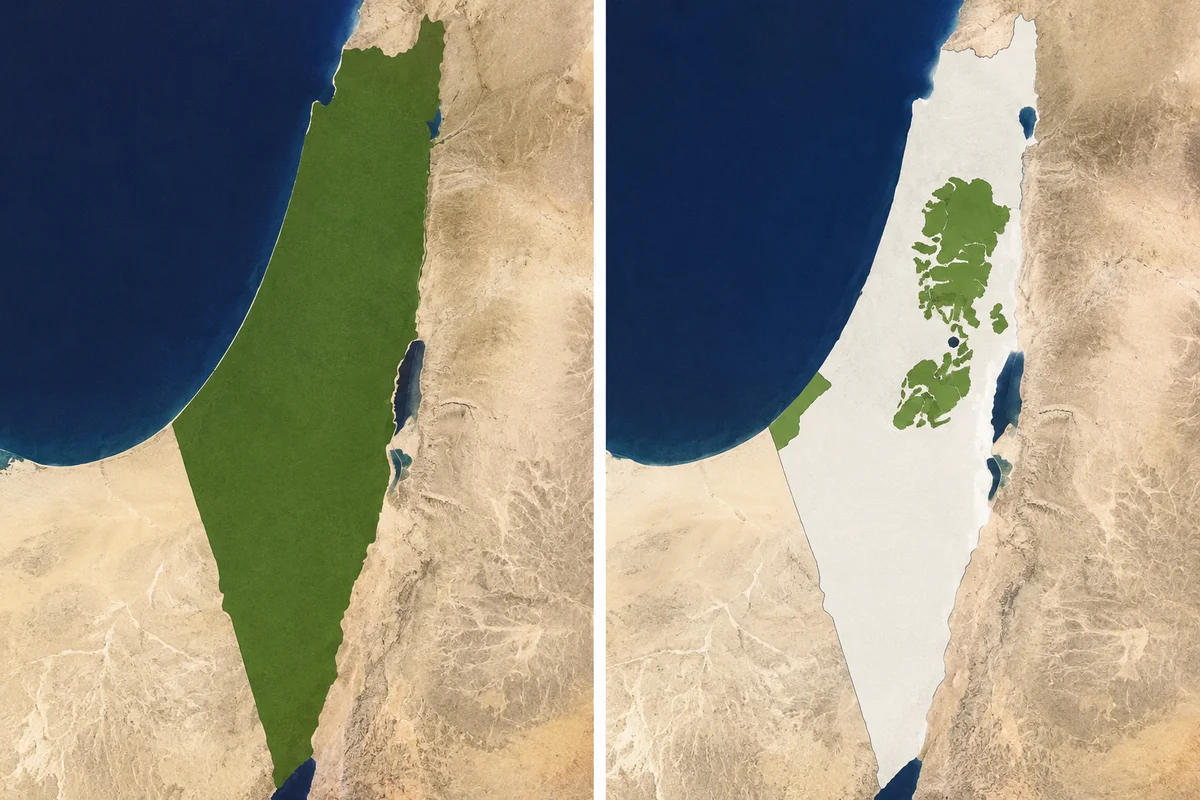
Maps showing the shrinking of Palestinian-held land over the past century circulate widely online as a kind of visual shorthand for the conflict. They compress a hundred years of wars, diplomacy and competing national claims into a handful of frames, and that compression is exactly why supporters find them clarifying and critics find them misleading. Neither reaction settles the underlying dispute, which remains open in 2026 even as the shape of the conflict has changed again this year.
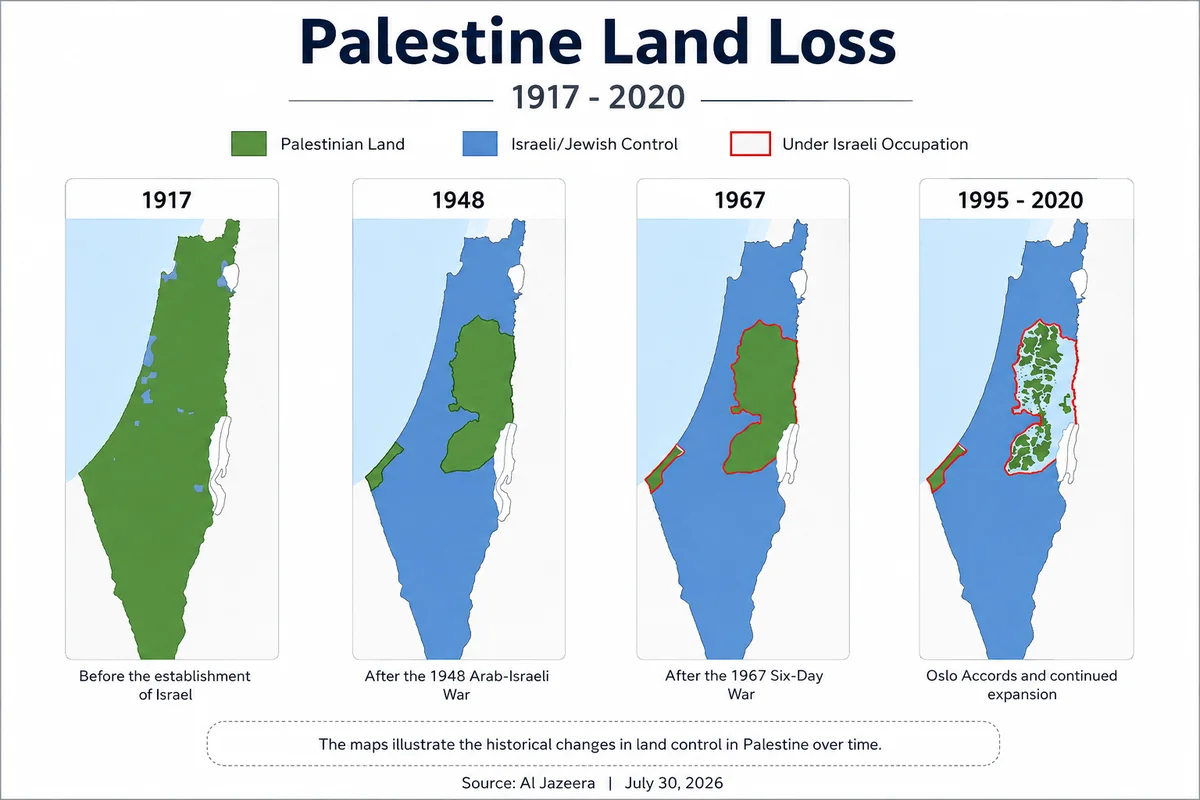
The territory's modern history begins with the collapse of the Ottoman Empire after World War I, when Britain assumed administrative control of Palestine under a League of Nations mandate. The population at the time included an Arab Palestinian majority alongside long-established Jewish communities, and Jewish immigration increased through the Mandate period, particularly after Britain's 1917 Balfour Declaration expressed support for a "national home for the Jewish people" in Palestine. Palestinian Arab leaders opposed the policy as a threat to their own political future, and tension between the two communities built steadily over the following three decades.
In November 1947, the United Nations proposed dividing Palestine into separate Jewish and Arab states. Jewish leaders accepted the plan; Arab leaders in Palestine and in neighboring states rejected it, arguing it gave a disproportionate share of the land to the proposed Jewish state given the existing Arab majority. Israel declared independence on May 14, 1948, and war followed immediately. By the time fighting ended in 1949, Israel held more territory than the UN plan had allocated to it, Jordan administered the West Bank, and Egypt administered Gaza. Roughly 700,000 Palestinians fled or were expelled from their homes during the conflict, according to widely cited historical estimates. Palestinians mark the episode as the Nakba, or catastrophe; Israelis mark the same war as their war of independence. Both framings persist today, and the argument over which one better describes 1948 remains unresolved among historians on both sides.
The 1967 Six-Day War reshaped the territorial map again. Israel captured the West Bank, East Jerusalem, Gaza, the Golan Heights and the Sinai Peninsula. Egypt regained Sinai under the 1979 peace treaty, but Israel has continued to hold the West Bank and annexed East Jerusalem, a step most of the world does not recognize. The United Nations and most countries regard the West Bank, including East Jerusalem, as occupied Palestinian territory under international law. Israel disputes aspects of this legal characterization, a disagreement most visible in the debate over settlements.
Israel and the Palestine Liberation Organization signed the Oslo Accords in the early 1990s, establishing the Palestinian Authority and dividing the West Bank into Areas A, B and C, each with different levels of Palestinian and Israeli control. The accords were meant to produce a final peace agreement within a few years. More than three decades later, the core issues the accords deferred, borders, settlements, refugees, Jerusalem and security, remain unresolved.
Israeli settlement construction in the West Bank is among the most disputed of those issues. The United Nations, the International Court of Justice and most countries consider the settlements illegal under international law. Israel disputes that conclusion, arguing the West Bank is disputed rather than occupied territory in a strict legal sense, since no state held internationally recognized sovereignty over it before 1967, and citing historical, legal and security considerations for its presence there. Settlement expansion has significantly altered the West Bank's map over the decades and is widely cited, including by past international mediators, as one of the central obstacles to a negotiated settlement.
Gaza followed a separate path. Israel withdrew its settlers and military from the territory in 2005. Hamas took control after fighting with the rival Fatah movement in 2007, and the two decades since have included a sustained Israeli and Egyptian blockade and several rounds of war between Israel and Hamas. Israel has said restrictions on Gaza are necessary given repeated rocket fire and militant activity originating there; United Nations agencies and human rights organizations have said the restrictions, independent of their stated justification, have contributed to a severe and prolonged humanitarian crisis for Gaza's roughly two million residents.
The deadliest phase of that conflict began on October 7, 2023, when Hamas-led gunmen killed approximately 1,200 people in Israel and took more than 250 others hostage, according to Israeli figures widely cited by international media. Israel responded with a large-scale military campaign across Gaza that continued for two years. According to Gaza's Ministry of Health, as cited by the United Nations, at least 73,356 Palestinians had been killed and more than 170,000 injured between October 2023 and early August 2026. The ministry's figures do not distinguish between combatants and civilians, and Israel has periodically disputed their reliability, though it has not published a comprehensive competing count of its own. Separately, independent household mortality surveys published in The Lancet Global Health have estimated the true toll is higher than the ministry's running count, not lower, concluding that the administrative tally functions as a floor rather than an inflated figure.
A ceasefire brokered by the United States under a 20-point plan announced by President Donald Trump took effect on October 10, 2025, ending the war's most intensive phase. Hamas released the remaining living hostages soon after, and by January 2026 had returned the remains of the last hostage held from the 2023 attacks, completing the terms of the ceasefire's first phase. Trump then established an international body called the Board of Peace, which he chairs, to oversee the plan's second phase: Hamas's disarmament, an Israeli troop withdrawal, and the installation of a Palestinian technocratic administration to govern Gaza's reconstruction. The board held its first meeting in Washington in February 2026 with representatives from roughly two dozen member countries; it does not include Palestinian representation on the board itself, a structure some human rights researchers have criticized as resembling external trusteeship over Palestinian affairs.
The ceasefire has not been fully observed. Israel and Hamas have repeatedly accused each other of violations, and United Nations monitors have continued to record Palestinian deaths in Gaza in the months since the truce took effect, from continued airstrikes, shootings and other incidents. By early August 2026, the reported toll since the ceasefire began had reached 1,230 killed and more than 4,000 injured, according to Gaza's health ministry, and has continued to climb since the truce was announced. Humanitarian conditions have improved from the war's peak but remain difficult: aid groups operating in Gaza continue to report shortages of fuel, medical equipment and clean water, along with import and access restrictions that slow reconstruction and evacuation of the sick and wounded.
In the final days of July 2026, the Board of Peace announced what Trump called a historic breakthrough: an agreement, reached through talks in Cairo, for Hamas to fully disarm. The two sides have since offered conflicting accounts of what was actually agreed. Hamas has said it will not proceed until Israel meets its own obligations under the ceasefire, chiefly a further troop withdrawal, while an Israeli official told Reuters that Israel would not withdraw further until Hamas disarms first. Palestinian Islamic Jihad, a separate militant faction that is also party to the ceasefire, said reports of a completed agreement were inaccurate. Within Israel's own government, the settlements minister publicly objected to the process on social media, describing it as a deal negotiated over Israel's head and rejecting any suggestion it would bind Israel. The Board of Peace has published a roadmap for the disarmament process, under which heavy weapons would be decommissioned and stored under the supervision of Gaza's new civilian administration rather than handed to Israel or to any non-Palestinian party. As of this writing, it remains unclear whether that roadmap will hold; strikes and casualties in Gaza have continued even as the announcement was made.
Maps of shrinking Palestinian territory circulate widely because they offer something the history above resists: a simple answer. Those who share them say the maps make an otherwise dense and contested history legible at a glance. Critics, including some historians and legal scholars, say the same maps collapse distinct legal and political concepts, sovereignty, military occupation, private land ownership and administrative control under the Oslo framework, into a single shaded color, obscuring rather than clarifying how any specific parcel of land is actually governed at a given moment.
More than a century after the British Mandate began, the core questions it left unresolved, over borders, Jerusalem, refugees and the terms of Palestinian self-governance, remain open. Gaza's ceasefire, not yet a year old and still being tested week to week, has changed the shape of the conflict without resolving what caused it. Whether the current disarmament roadmap holds, collapses or is renegotiated again will be decided in the coming months, not by this article.
Latest News
- CBI Files FIR Against Anil Ambani Over ₹1,816 Cr EPFO Loss
- New Zealand Introduces English Official Language Bill
- Israeli Strikes Kill 6 in Gaza Amid Cairo Talks
- AISA Says NEET Protest Will Continue, Seeks Release of Students
- Bombay High Court Grants Nitin Gadkari Leave to Sue Meta, X, Google
- Delhi Transporters Announce August 4 Parliament March Over E20 Petrol
- Drone Crashes Near Itamar Ben-Gvir's Residence in Hebron
- From Students to a Nationwide Movement: The CJP Protest Explained
- Ukraine Claims Russia Preparing to Deploy 30,000 North Korean Troops
- UK Inquest Rules Saudi Prince's Death a Misadventure in London