South Korea's Lee Calls for North Korea Talks to Replace Korean War Armistice With Peace Regime
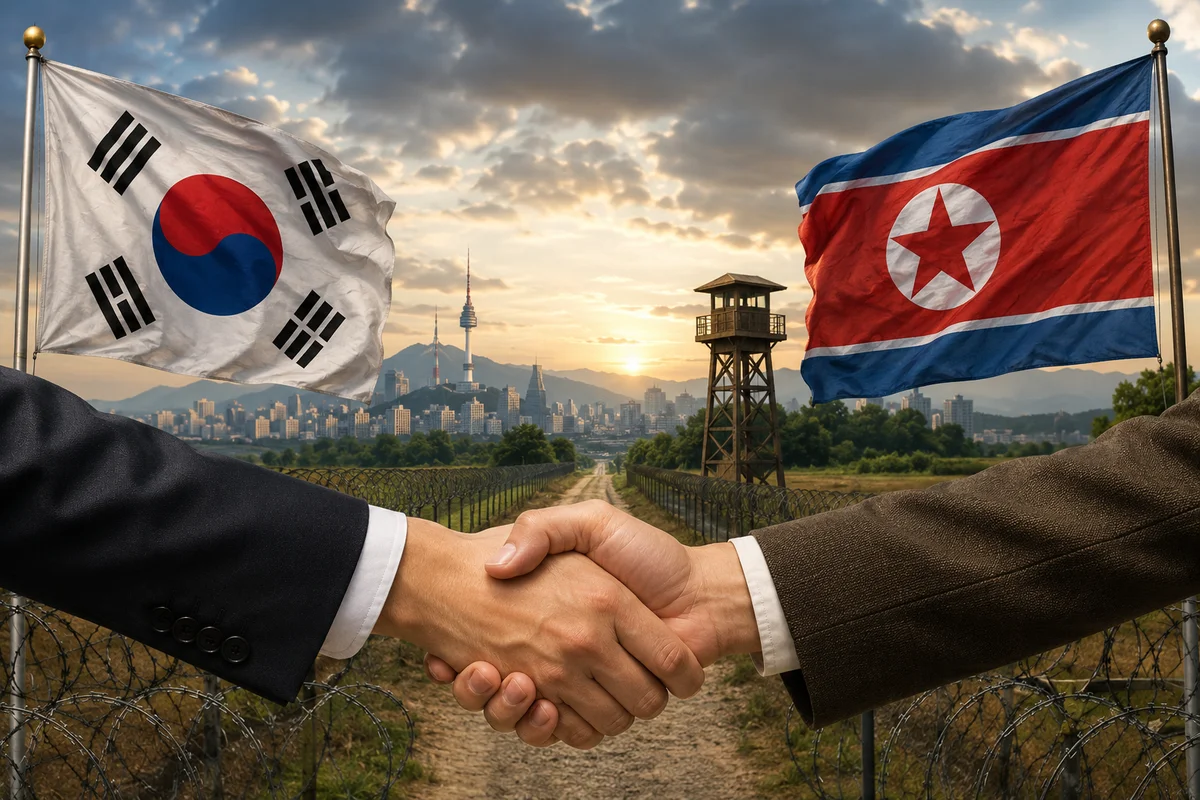
SEOUL, August 15, 2026. South Korean President Lee Jae Myung called on Saturday for renewed talks with North Korea to formally end the Korean War and replace the peninsula's decades-old armistice with a permanent peace regime.
Lee made the proposal during a speech marking South Korea's 81st National Liberation Day, which commemorates the country's liberation from Japanese colonial rule in 1945.
He urged the two Koreas to move away from confrontation and begin discussions toward peaceful coexistence. "Let us put down our intentions to threaten each other and begin discussions to end the long-running war as the directly involved parties," Lee said, according to Yonhap.
He added that the talks could also address practical measures to halt the advancement of North Korea's nuclear capabilities.
The Korean War, fought from 1950 to 1953, ended with an armistice rather than a formal peace treaty. The agreement stopped large-scale fighting but did not officially end the state of war between North and South Korea.
Lee said his government wants to move away from what Seoul regards as an unstable armistice system and build a more permanent framework for peace. South Korea, he said, would take proactive and sustained steps to reduce military tensions and establish multiple safeguards to prevent disputes from escalating into armed conflict.
The proposal forms part of Lee's broader engagement policy toward Pyongyang. His government has emphasized peaceful coexistence and said Seoul respects North Korea's political system rather than seeking unification through absorption.
Lee's proposal does not separate the peace talks from the security concerns surrounding North Korea's nuclear program. He said discussions between the two sides could explore "effective ways" to halt the advancement of Pyongyang's nuclear capabilities, raising the possibility that negotiations to formally end the Korean War could be combined with measures aimed at controlling North Korea's expanding nuclear and missile programs.
It remains unclear whether Pyongyang would accept such discussions.
North Korea has continued to strengthen its military capabilities and has repeatedly rejected Seoul's previous offers of engagement.
Relations between the two Koreas remain deeply strained despite Lee's repeated calls for dialogue. North Korean leader Kim Jong Un has abandoned Pyongyang's earlier policy of pursuing reunification with the South and has increasingly characterized Seoul as a hostile state. North Korea has also criticized South Korea's military cooperation with the United States and criticized Seoul's plans to acquire nuclear-powered submarines.
The situation has been further complicated by upcoming joint U.S.-South Korean military exercises. North Korea recently condemned the planned Ulchi Freedom Shield exercises, accusing Washington and Seoul of escalating military tensions and warning that Pyongyang would strengthen its nuclear deterrent. The exercises are scheduled to run from August 17 to August 27. Pyongyang has also continued developing and testing ballistic missile systems, adding to concerns over the possibility of further escalation.
Lee's latest proposal is consistent with his government's increasingly engagement-focused approach. Rather than treating North Korean denuclearization as a prerequisite for dialogue, Seoul has placed growing emphasis on reducing military tensions and creating the conditions for negotiations. The ultimate objective remains addressing North Korea's nuclear program, but Lee's administration has argued that lowering tensions and establishing a framework for dialogue could help create the conditions necessary for progress. The approach marks a contrast with policies that have prioritized denuclearization before broader political engagement.
Replacing the 1953 armistice with a permanent peace regime would represent a major change in the security structure of the Korean Peninsula. For more than seven decades, the armistice has kept large-scale fighting halted without ever being transformed into a comprehensive peace treaty. A formal peace arrangement could potentially address military confidence-building measures, mechanisms for preventing accidental clashes and the broader political relationship between Seoul and Pyongyang.
Such an agreement would likely extend beyond the two Koreas alone. The United States, which maintains a major military presence in South Korea, would be expected to factor into any discussions over the peninsula's security structure. The nuclear issue would remain one of the most difficult challenges.
Lee's Liberation Day speech also addressed South Korea's relationship with Japan. He called for Seoul and Tokyo to confront the painful history of Japan's colonial rule while building a stronger relationship for the future, and said he hoped South Korea and Japan could begin a new period of peace and prosperity as close neighbors. The balancing of historical disputes with closer regional cooperation carries particular weight as security tensions continue to grow across Northeast Asia.
Lee's proposal does not mean the Korean War has been formally ended or that a peace treaty is imminent. It represents, instead, a renewed call for negotiations.
The immediate question is whether Pyongyang will respond positively to Lee's proposal. So far, North Korea has shown little willingness to resume substantive dialogue with Seoul, continuing instead to emphasize military strength while deepening military ties with countries including Russia. That makes Lee's speech an important diplomatic signal, but not yet a breakthrough. For negotiations to begin, Seoul will need Pyongyang to reconsider its current position and return to some form of structured dialogue.
Latest News
- Greater Israel: How Ideology Is Becoming Facts on the Ground
- BJP, Meta and India’s Growing Power Over Online Content
- USCIRF Seeks Sanctions on RSS Ahead of Mohan Bhagwat’s US Visit
- Gaza Death and Injury Toll Exceeds 11% of Pre-War Population
- Humanoid Robots Could Patrol U.S. Southern Border
- Ukraine Corruption Concerns Put Pressure on EU Accession
- Hefner Contacted FBI Over Epstein in 2005, Lawsuit Says
- Five Shot Near Virginia State University Dorms; One Critical
- Cristiano Ronaldo Marries Georgina Rodriguez in Portugal
- Bashar al-Assad Sentenced to Death in Absentia