BJP’s Digital Shake-Up Raises Bigger Questions About Who Controls India’s Online Speech
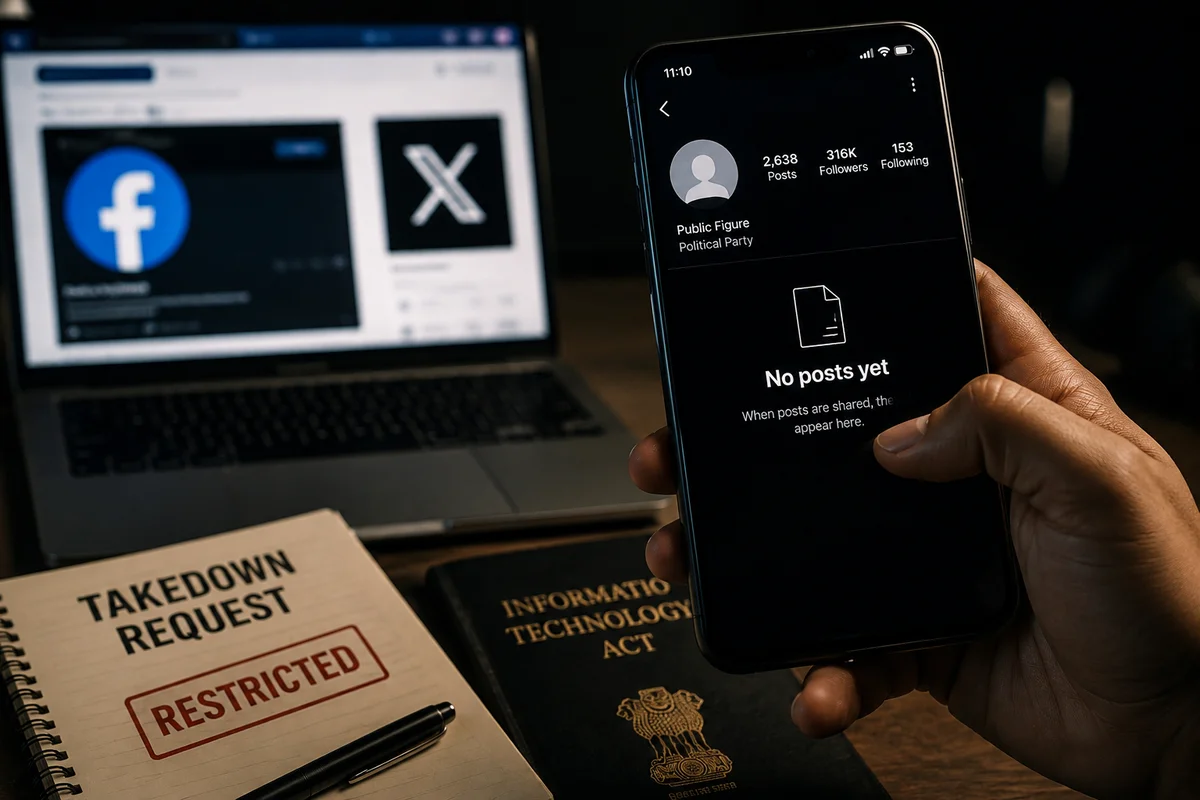
India's political battles are no longer confined to rallies, television studios and newspaper columns. Increasingly they play out on X, Instagram, Facebook, YouTube and messaging platforms, where parties compete to shape public opinion and citizens organize, debate and challenge those in power.
That contest came into sharp focus on August 17, 2026, when the ruling Bharatiya Janata Party replaced Amit Malviya with Deepak Mhaskey as its national social-media convenor. Priti Gandhi, Shivanand Dwivedi, Alok Bhatt and Arun Yadav were named co-convenors alongside him. Reuters reported that the reshuffle followed youth-led protests in which social media had played a significant role.
Within hours, attention shifted from the BJP's new digital strategy to the online histories of its incoming officials. Alt News and The South First reported that several of the officials' previously accessible X accounts or posts had disappeared, gone private or otherwise become inaccessible. Alt News said the accounts of four newly appointed co-convenors had either vanished or had their posts rendered inaccessible shortly after the appointments were announced. India Today reported separately that the timelines of Priti Gandhi and Alok Bhatt were no longer accessible, and that neither the BJP nor the two officials had immediately explained the changes.
The disappearance of old posts has raised questions about political accountability, online reputation management and the permanence of the public record. It has also produced a larger question: when political content vanishes from the internet in India, who decided that it should vanish? The user, the platform, the courts or the government?
The evidence currently available does not establish that the Indian government ordered Meta or any other platform to remove the old posts of the BJP's newly appointed officials. That distinction is central to understanding what has and has not been proven. What can be established is that India maintains a powerful legal and regulatory system governing online content, that government requests for takedowns occur on a large scale, and that platforms such as Meta operate systems for responding to those requests and to local-law restrictions more broadly. The BJP controversy offers a useful starting point for examining that broader question.
The BJP's decision to replace Malviya, who had served as the party's social-media head since 2015, marked a significant reorganization of its digital operation. Mhaskey was chosen to succeed him, with Gandhi, Dwivedi, Bhatt and Yadav joining the national social-media leadership structure alongside him. The change came at a politically sensitive moment. Reuters reported that youth-led protests had underscored the growing power of social media as a tool for political organizing and communication, while ThePrint reported that BJP figures had voiced concern about a perceived disconnect between the party's established digital strategy and younger voters. Mhaskey later said the party's digital operation would focus on countering what it considers propaganda and correcting public misconceptions.
The party was not simply changing personnel. It was changing part of the machinery through which it communicates with millions of voters online, and the digital past of that new machinery quickly came under scrutiny. Alt News reported that, shortly after the announcement, the accounts of four co-convenors had either disappeared or become inaccessible. The outlet also observed a drop of 1,342 in the number of visible posts on Mhaskey's X account between its observations after the BJP announcement, from 6,905 to 5,563. India Today reported separately that old posts belonging to Gandhi and Bhatt were no longer visible, with no immediate explanation from the BJP or the officials themselves. The South First reported that Mhaskey's earlier posts had been removed or archived, that Gandhi's and Bhatt's pages were no longer visible, and that the accounts of Dwivedi and Yadav had been made private.
Why did multiple online histories become less accessible immediately after the officials received prominent digital communications roles? That is the obvious question. A quieter one matters just as much: what exactly caused the disappearance? An account owner can voluntarily delete posts or switch an account to private. A platform can remove content under its own community standards. A platform can restrict content in a particular country because it is alleged to violate local law. A court can order action. Or an authorized government agency can invoke a legal process for restricting access. Without identifying the mechanism behind a particular removal, it is not possible to conclude that the government or Meta was responsible, and that evidentiary distinction should remain at the center of any responsible investigation.
Scrutiny of the new team has not been limited to disappearing accounts. Screenshots and archived material attributed to some of the officials have circulated widely, with reports alleging misogynistic, casteist, communal and anti-Muslim remarks. The South First published examples attributed to Bhatt and Gandhi, including alleged historical comments concerning reservation, Muslims, women and Nathuram Godse. The outlet also reported that Yadav had previously been removed from the BJP's Haryana IT-cell leadership following backlash over controversial remarks about Muslims. Alt News likewise reported that previously accessible accounts or posts had become unavailable, and documented efforts to recover older material through screenshots and other records.
Social-media screenshots require careful verification, though. A screenshot can establish that an image circulated, but it does not by itself establish complete context, original publication date, the authenticity of the account, or whether a post was altered. Claims about individual historical posts should therefore be treated as allegations unless independently authenticated through archived pages, platform records, contemporaneous reporting or other primary evidence, a standard that matters most when accusations involve inflammatory claims about religion, caste or gender.
The wider investigation begins with a more established fact: the Indian government has legal mechanisms for restricting online content, and not all of them work the same way. Section 69A of the Information Technology Act, 2000, allows the central government or an authorized officer to direct the blocking of public access to information on specified grounds, including India's sovereignty and integrity, defense, state security, friendly relations with foreign states and public order. The Supreme Court upheld the constitutional validity of Section 69A in its 2015 judgment in Shreya Singhal v. Union of India, while emphasizing the statutory grounds and procedural safeguards that govern the power.
A separate mechanism, Section 79(3)(b), concerns intermediary-liability obligations rather than direct blocking orders, and it is this provision under which government notices sent through the Union Home Ministry's Sahyog portal have been described. Not every government takedown notice discussed in this investigation is issued under Section 69A, and the two mechanisms should not be treated as interchangeable, even though both fall under India's broader content-regulation framework. Section 69A is not an unlimited authority to remove material simply because the government objects to it. It operates within a defined legal framework, and online censorship debates often collapse several distinct mechanisms into one. A government request is not necessarily the same as a platform-policy removal. A platform-policy removal is not necessarily the same as a court-ordered restriction. A lawful government blocking order is not automatically proof of political censorship. Each case requires its own evidence.
Meta, for its part, has acknowledged that governments worldwide submit requests involving online content, and has described systems under which content may be restricted in a particular jurisdiction when it is alleged to violate local law, even when it does not otherwise violate the company's community standards. Meta has said it reviews such requests and can push back when they are legally deficient or inconsistent with its policies and human-rights commitments, and it has introduced notifications intended to tell users when content has been restricted in response to a government request, distinguishing those local-law restrictions from removals made under its own community standards. Governments can, in short, submit legal requests that may result in country-specific restrictions on content, subject to the applicable legal and platform processes. But that is very different from saying a government has unrestricted power to order Meta to delete political speech, and no evidence reviewed for this investigation shows that the Indian government used this mechanism to remove the old posts of the BJP's new social-media officials.
The regulatory backdrop has nonetheless grown considerably stricter. In February 2026, India amended its Information Technology Rules, requiring platforms to act within three hours on specified unlawful-content notifications, down from an earlier 36-hour window. The change took effect on February 20. Reuters reported that legal experts had questioned whether such a short response period could make it harder for platforms to properly assess complicated cases.
The change creates a real policy tension. Some content should be removed rapidly: fraud, child sexual-abuse material and other clearly unlawful content can cause immediate harm. Political speech is often more complicated. A post can be offensive, misleading or controversial without necessarily being unlawful, and the faster a platform must act, the more important legal clarity, internal review and appeal mechanisms become. The question is not simply whether content is removed quickly, but whether the process behind that removal is accurate, transparent and reviewable.
Available data show that interaction between the Indian state and online platforms is already occurring at scale. The Indian Express, citing information obtained under the Right to Information Act, reported that government agencies using the Sahyog portal sent 2,312 blocking orders to 19 online platforms between October 2024 and October 2025. Meta-owned services accounted for more than 78 percent of those orders, including 1,392 involving WhatsApp, 255 involving Facebook and 169 involving Instagram; YouTube received 176 and Telegram 123. That figure counts orders rather than necessarily individual pieces of content, since a single order can cover multiple URLs or accounts, and it describes a different period, and a different legal mechanism, than the more recent figures below.
According to a PIB Fact Check clarification reported on August 20, around 2.98 lakh URLs were sent to social-media platforms for takedown between March and July 2026. PIB Fact Check said about 2.44 lakh of those, or 82 percent, were sent by state authorities, while approximately 51,000 came from the Indian Cyber Crime Coordination Centre, primarily in connection with cyber, infrastructure and stock-investment scams. Those component figures are the government's own rounded numbers and do not sum exactly to the reported total. The safer conclusion is narrower than any single figure: government takedown requests and notices are occurring on a very large scale, and the volume of interaction between the state and digital platforms has become a significant feature of India's online environment.
The government has also pushed back on suggestions that this volume of activity means content is being removed without human review. In the same August 20 clarification, the PIB Fact Check unit said the Sahyog API integration with Meta was established in 2025 at Meta's own request, and that only authorized officers can submit takedown intimations through the system. The government rejected characterizations of the system as automatic blocking carried out to comply with the three-hour rule. That clarification, however, does not by itself resolve broader questions about transparency, legal review and how individual takedown decisions are made.
The debate has not stopped at the three-hour requirement. In March 2026, the government proposed amendments that would make certain advisories and clarifications to online platforms legally binding, linking non-compliance to the loss of safe-harbor protections that generally shield platforms from liability for user-generated content. Reuters reported that the proposal was presented for public feedback and, at that stage, was not yet a final rule, a distinction that matters, since a proposal is not enacted law. Even so, it illustrates the direction of the regulatory debate: greater government authority and faster platform compliance, alongside stronger obligations on technology companies.
The relationship between the Indian government and Meta is not simply one in which officials request removals and Meta complies. In July 2026, Facebook temporarily restricted a post by Prime Minister Narendra Modi. Meta later described the restriction as an operational error and apologized after the government summoned company executives, and Reuters reported that the incident became part of wider tensions between New Delhi and the company over moderation and compliance.
The episode is instructive. It shows that platforms can independently make moderation decisions affecting even highly powerful political figures, and how quickly those decisions can become matters of government concern. A separate episode underscores the same tension. Reuters reported that Hyderabad police registered a case against Meta India head Arun Srinivas over Facebook videos that allegedly portrayed Modi in an abusive manner, and that legal experts questioned why an individual technology executive had been named personally, stressing that personal liability would ordinarily require evidence of direct involvement and awareness. Together, the incidents suggest a more complex relationship than a simple chain of command.
India is not alone in this. In Turkey, Instagram was blocked nationally in August 2024 after authorities criticized the platform over restrictions involving posts concerning Hamas political leader Ismail Haniyeh; access was restored after negotiations. The broader pattern is global. Governments increasingly demand faster removal of unlawful material and greater control over digital services, while technology companies navigate competing demands from local law, their own content rules and commitments to freedom of expression.
So what does the BJP case actually show? Based on the evidence currently available, the answer is limited but significant. It shows that the party's new social-media leadership came under intense scrutiny over its members' previous online activity almost immediately, and that multiple previously accessible posts or accounts became inaccessible, private or deactivated around the time of the appointments, according to multiple reports. It raises legitimate questions about whether political figures should be able to erase their public digital histories when they assume influential roles.
What it does not currently prove is that the Indian government ordered Meta to remove those posts, that Meta removed them at the government's request, or that every screenshot circulating online is authentic. Those are separate questions requiring separate evidence, and the distinction matters because to an ordinary user the result can look identical regardless of cause: deleted by the account owner, removed under community standards, restricted under Indian law, blocked by a court, or taken down after a government request. The post is simply gone.
That is what makes transparency essential. Users should be able to know, where legally possible, whether an action resulted from a government request, a court order, a platform policy or the user's own decision. Meta has already developed systems for notifying users when content is restricted because of government requests. Governments, for their part, should provide clear legal bases for restrictions and maintain meaningful avenues for review. Without that chain of accountability, citizens cannot easily distinguish lawful regulation from political pressure.
The next stage of this investigation should be evidence-driven. When exactly did each account go private or lose access to its historical posts? Were the changes voluntary? Did any platform or government authority issue a notice? Who made the final decision in each case? Those questions could convert a politically charged controversy into a verifiable investigation.
The BJP's new social-media team has come under scrutiny after reports that several officials' older posts or accounts became inaccessible following their appointments. The controversy has raised questions about political accountability and the preservation of public digital records. India, meanwhile, has a growing legal and regulatory system through which authorities can seek restrictions on online content, while platforms such as Meta maintain mechanisms for responding to government requests. There is, however, no evidence at present linking the disappearance of the BJP officials' posts to a government-ordered Meta takedown.
The larger question remains. When political content disappears online, can the public know who removed it, under what authority, and whether the decision can be challenged?
Latest News
- Greater Israel: How Ideology Is Becoming Facts on the Ground
- USCIRF Seeks Sanctions on RSS Ahead of Mohan Bhagwat’s US Visit
- Gaza Death and Injury Toll Exceeds 11% of Pre-War Population
- Humanoid Robots Could Patrol U.S. Southern Border
- Ukraine Corruption Concerns Put Pressure on EU Accession
- Hefner Contacted FBI Over Epstein in 2005, Lawsuit Says
- Five Shot Near Virginia State University Dorms; One Critical
- South Korea’s Lee Calls for North Korea Peace Talks
- Cristiano Ronaldo Marries Georgina Rodriguez in Portugal
- Bashar al-Assad Sentenced to Death in Absentia