Humanoid Robots Could Patrol U.S. Southern Border as Foundation Pitches AI-Powered Surveillance
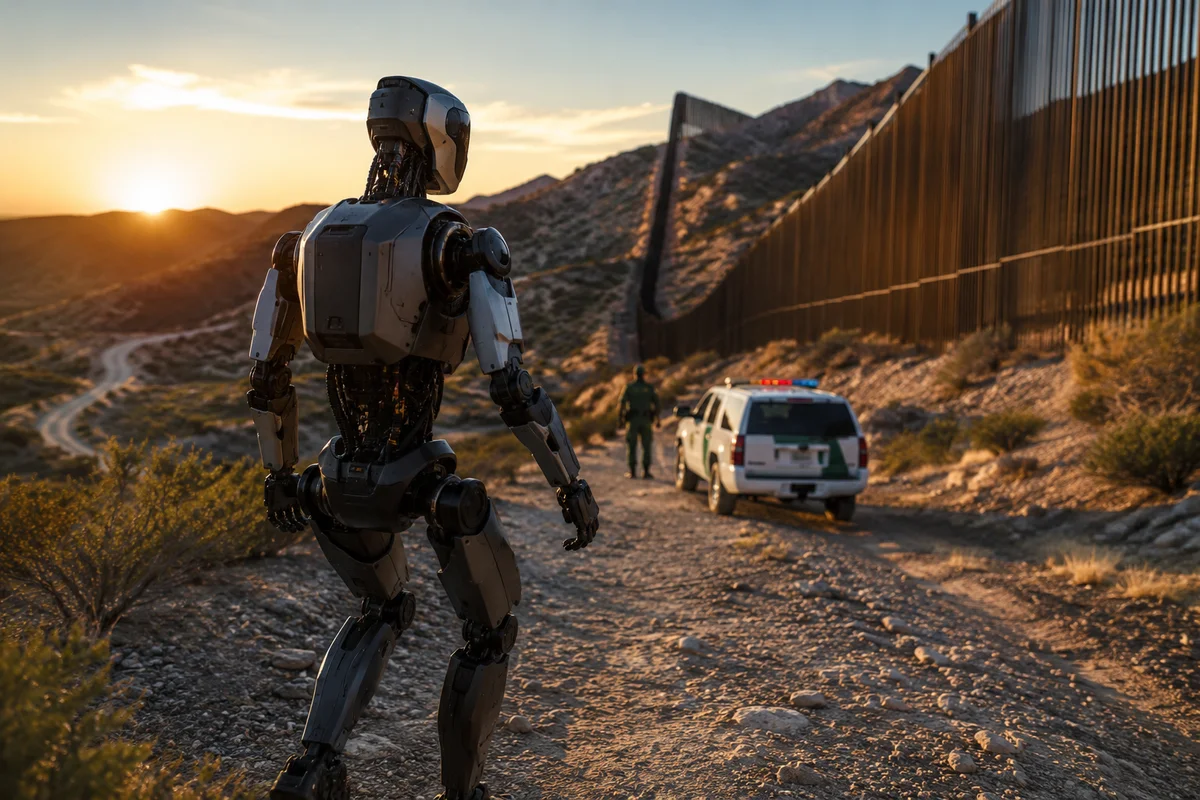
United States: Robotics company Foundation is pitching its Phantom humanoid robot as a potential tool for monitoring the U.S. southern border, with the company envisioning the platform assisting federal agents with surveillance and reconnaissance in rugged terrain while reducing risks to human officers. But the robots are not currently patrolling the southern border. A U.S. Department of Homeland Security (DHS) spokesperson told Fox News Digital that the department currently has no non-contractual agreements, pilots or active prime contracts with Foundation, meaning the technology remains a potential next step in the automation of border surveillance rather than a confirmed deployment or an operational border-security program.
Foundation founder and CEO Sankaet Pathak told Fox News Digital that the company has already demonstrated its humanoid robot to DHS officials and is in discussions with several U.S. national-security agencies, including the Air Force, Navy, Army and DHS.
The company believes humanoid robots could fill a gap between existing surveillance systems and human patrols. Drones, surveillance towers, cameras and other technologies already play an important role in monitoring the southern border, but Foundation argues that these systems cannot physically navigate every environment. "If drones and watchtowers were able to solve for everything, why do we still have humans at the border?" Pathak said. His argument is that humanoid robots could operate on the ground in places where vehicles, aerial drones or fixed cameras face limitations.
Foundation's proposed border role is focused primarily on surveillance and reconnaissance rather than replacing human Border Patrol agents. According to Pathak, Phantom is designed to navigate uneven terrain, detect people and map its surroundings autonomously. Under the proposed system, a robot could move through an area autonomously, identify potentially significant activity and then flag it for human officers, who would remain responsible for deciding what happens next. "They will detect and then flag and then a human would decide kind of like what the next step it needs to be," Pathak said. That would make the system a form of human-supervised autonomous surveillance rather than a robot independently making enforcement decisions.
Underground tunnels are another possible application Foundation has identified. Tunnels can pose significant risks to human personnel because they may be confined, unstable or difficult to inspect, and a humanoid robot capable of navigating such environments could potentially be sent ahead of human officers to conduct reconnaissance. Foundation's broader argument is that robots could take on dangerous or repetitive physical tasks while keeping human personnel at a safer distance. Pathak said the company wants its machines to be capable of continuous surveillance, potentially allowing robots to monitor areas for extended periods. "Our biggest thing is if we can keep our officers in a safe place, and these robots can continue to surveil 24/7," he said. That 24/7 concept is currently a company vision, not evidence that robots are already providing continuous surveillance on the border.
Pathak suggested a pilot project could begin quickly. "Tomorrow I think we could do a pilot. Next couple of months we can do something much larger," he said. That statement reflects the company's ambition rather than a government-approved deployment schedule, and DHS has confirmed it currently has no pilot or active prime contract with Foundation. No DHS deployment date for Phantom robots along the southern border has been announced.
Weather resistance remains a significant limitation of the current Phantom model, Pathak said. Foundation says a second-generation version is being developed with greater outdoor durability, including waterproof and dustproof capabilities and a more rugged design, which would be particularly important for potential border deployment given the heat, dust, rain, uneven terrain and other environmental conditions robots could face there.
The possibility of armed humanoid robots adds another dimension to Foundation's proposal. Pathak told Fox News Digital that Foundation would be willing to arm its robots for border operations if the federal government requested such a capability, but he stressed that the company's immediate vision for the border is centered on surveillance and reconnaissance, with the proposed system keeping humans responsible for enforcement decisions. That distinction is important: there is currently no evidence that armed Phantom robots are being deployed to independently patrol or enforce immigration law along the southern border. Still, the idea raises significant questions about accountability, human oversight, artificial intelligence and the use of force if the technology is eventually deployed.
The border proposal comes as Foundation expands its humanoid robotics work into national-security and military applications. Two Phantom robots were sent to Ukraine in February 2026, initially for frontline-reconnaissance support, according to TIME. The company's work in Ukraine has highlighted the challenges of operating humanoid robots outside controlled industrial environments.
Foundation has also been working to scale up production of the Phantom platform. In July, Reuters reported that Foundation partnered with semiconductor company AMD to develop autonomous humanoid robots for military and industrial applications. The next-generation Phantom MK-2 is planned to use AMD's Ryzen AI Embedded X100 Series processors. Reuters also reported that Foundation plans to open a manufacturing facility in October with an annual production capacity of about 5,000 robots, followed by plans for a larger facility capable of producing up to 50,000 robots annually. Foundation was founded in 2024 and says its Phantom platform is designed to perform physical tasks in environments built for humans; its website currently showcases Phantom demonstrations, including a heavy-payload demonstration conducted in July 2026.
The proposed use of humanoid robots represents a different approach to border surveillance. A drone can provide an aerial view of a large area, a fixed camera or surveillance tower can continuously monitor a particular location, and a vehicle can cover significant distances quickly. A humanoid robot, meanwhile, is intended to physically move through environments designed for people, which could theoretically allow it to climb, walk across uneven ground, inspect structures and enter areas where conventional vehicles may struggle. Foundation believes this physical flexibility could make humanoids useful for reconnaissance in remote or difficult terrain, though these capabilities still need to be demonstrated reliably under real-world border conditions.
Deploying autonomous humanoid robots across the southern border would involve challenges that go far beyond demonstrating a robot in a controlled environment. The machines would have to operate reliably in extreme temperatures, dust, rain, uneven terrain and potentially poor communications conditions. Battery life would be an important consideration, and so would cybersecurity: a robot connected to communications networks and capable of autonomous navigation could become a target for interference or hacking. There is also the question of identification accuracy. If an autonomous system incorrectly identifies a person or activity as suspicious, a human officer could potentially respond based on an incorrect alert, and that is why human oversight would be particularly important in a law-enforcement environment.
The U.S. southern border is already monitored using a combination of human personnel and technologies including cameras, sensors, aircraft, drones and other surveillance systems, so Foundation is not proposing to introduce automation to a completely manual border. Instead, the company is pitching humanoid robots as another layer of surveillance between fixed infrastructure, aerial systems and human officers. The potential advantage would be a machine that can physically move through terrain while simultaneously using autonomous perception and navigation.
The next major step would likely be testing. Before a technology such as Phantom could become a regular part of border operations, government agencies would need to determine whether the robots can navigate real terrain reliably, operate for sufficiently long periods, communicate securely and accurately identify people and potential threats. A limited pilot, if approved, could provide answers to those questions, and if successful, humanoid robots could eventually become another tool used alongside human officers, drones, cameras, sensors and other surveillance systems. That stage, however, has not yet been reached.
If Foundation's vision becomes reality, the U.S. southern border could eventually see human officers working alongside autonomous ground robots. But whether that happens will depend on further testing, government procurement, operational requirements and decisions about how much authority should be given to autonomous machines.
Latest News
- Greater Israel: How Ideology Is Becoming Facts on the Ground
- BJP, Meta and India’s Growing Power Over Online Content
- USCIRF Seeks Sanctions on RSS Ahead of Mohan Bhagwat’s US Visit
- Gaza Death and Injury Toll Exceeds 11% of Pre-War Population
- Ukraine Corruption Concerns Put Pressure on EU Accession
- Hefner Contacted FBI Over Epstein in 2005, Lawsuit Says
- Five Shot Near Virginia State University Dorms; One Critical
- South Korea’s Lee Calls for North Korea Peace Talks
- Cristiano Ronaldo Marries Georgina Rodriguez in Portugal
- Bashar al-Assad Sentenced to Death in Absentia