From NEET Paper Leaks to Public Protests: Why Accountability Is Becoming India's Biggest Challenge
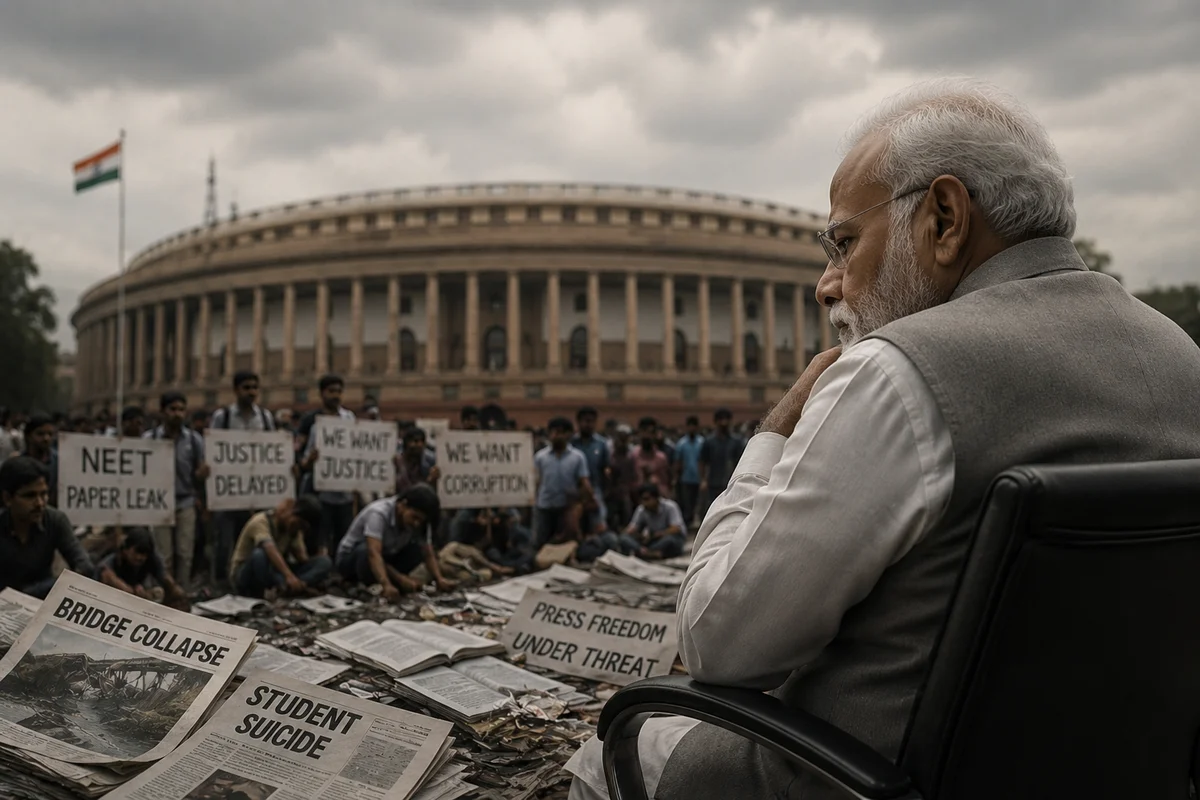
NEW DELHI — Over the past several months, a generation of Indian students has camped outside government offices and taken over a stretch of central Delhi with one demand: a minister's resignation.
The anger traces back to a familiar and painful cycle. In May, the National Testing Agency was forced to cancel NEET-UG, India's largest medical entrance exam, after hundreds of its questions turned up in a leaked "guess paper" just days before roughly 2.27 million students were due to sit it. It wasn't the first time. A similar scandal had struck the same exam in 2024. By mid-July, education reformer Sonam Wangchuk was well into a hunger strike over the issue, and a viral youth movement calling itself the "Cockroach Janta Party" was refusing to leave its sit-in at Jantar Mantar until Education Minister Dharmendra Pradhan stepped down.
The exam scandals are only one strand of a wider story. Government data itself acknowledges dozens of serious lapses in India's highway-building drive, including bridge and tunnel collapses that have trapped workers and cut off communities. Rights groups, meanwhile, warn that the space for dissent and independent journalism in India is narrowing. Together, the episodes have become a test of how the Bharatiya Janata Party-led government handles public anger, and how much of that anger rests on verified fact rather than rumour.
Key dates
- June 23, 2023 — Tunnel portal collapse, Ramban, Jammu and Kashmir
- July 19, 2023 — Tarnah Bailey Bridge, Jammu and Kashmir, badly damaged by record floods
- Late July 2023 — Three PWD bridges collapse in Himachal Pradesh and Haryana after flash floods
- Nov. 12, 2023 — Portion of the under-construction Silkyara tunnel collapses in Uttarakhand, trapping 41 workers; all are rescued after a 17-day operation
- Nov. 17, 2023 — Eastern portal of the Kohima tunnel collapses in Nagaland
- May 5, 2024 — NEET-UG 2024 held; social media reports of a leak begin
- Mid-2024 — Supreme Court told the CBI has identified 155 students who accessed a leaked paper; rules the breach was not "systemic" and declines to order a retest
- June 30, 2024 — A 130-foot Bailey bridge collapses on the Kurung River in Arunachal Pradesh after flash floods
- July 21, 2024 — Bundelkhand Expressway, opened in 2022, suffers rain-related road damage
- May 3, 2026 — NEET-UG 2026 held for roughly 2.27 million candidates
- May 12, 2026 — Exam cancelled over a paper leak; retest ordered
- May 15, 2026 — Pradhan admits the "command chain was breached"; announces a computer-based exam format from 2027
- June 1, 2026 — Students rally outside the Ministry of Education in Delhi, demanding Pradhan's resignation
- June 6, 2026 — "Cockroach Janta Party" begins an open-ended sit-in at Jantar Mantar
- June 14, 2026 — Congress president Mallikarjun Kharge calls for "zero tolerance" and Pradhan's resignation
- June 21, 2026 — NEET-UG retest held for about 1.7 million candidates
- July 14, 2026 — Wangchuk's hunger strike reaches its 17th day
Editor's Note: This timeline highlights a selection of major events relevant to the issues discussed in this article. It is not an exhaustive record. Numerous other protests, demonstrations, legal proceedings, infrastructure incidents and government actions took place during this period but are not included here for the sake of clarity and brevity.
A pattern of paper leaks
NEET-UG has now been at the centre of two major scandals in three years.
The first came in May 2024, when 2.4 million students sat the exam and reports of a leaked paper began circulating on social media almost immediately. Within days, authorities confirmed "significant overlaps" between the leaked material and the actual chemistry and biology questions. By mid-2024, the matter had reached the Supreme Court, where the CBI reported that 155 students had accessed the leaked paper — a small fraction, the court noted, of the roughly 20 lakh candidates who sat the test. Because the number was small, the court ruled the breach was not "systemic" and declined to order a retest. The results stood, though the episode left lasting damage to public trust, and student groups continued pushing for accountability from the National Testing Agency and the Education Ministry regardless.
The second scandal, in 2026, proved harder to contain. NEET-UG was held on May 3 for 22.3 lakh registered candidates. Within days, investigators found extensive overlap between the exam's chemistry and biology sections and a circulated "guess PDF." Rajasthan police and the CBI arrested multiple suspects, including school staff in Sikar and Godhra. On May 12, the National Testing Agency cancelled the exam "in the interest of students" and scheduled a free retest for June 21, ultimately taken by around 1.7 million examinees. Pradhan acknowledged the failure publicly, admitting that "the command chain was breached" despite existing safeguards, and promised "zero tolerance" for malpractice, tighter security, and a shift to a fully computer-based exam format starting in 2027. A CBI inquiry into the leak network is ongoing.
Other exams — the CBSE, UGC-NET and CUET among them — have also faced portal errors, delays and technical failures over 2025 and 2026, though none has drawn the sustained attention NEET has. That's largely a function of scale: with more than two million candidates a year, even a narrow leak touches an enormous number of students. Distressed examinees have described serious stress and financial strain in media interviews, and opposition leaders allege that close to half a dozen students died by suicide during the 2026 NEET saga, though official confirmation of individual cases remains limited.
As critics including Kharge describe it, the government's own position is that the leaks are the work of criminal networks, or "examination mafias," rather than evidence of deeper governance failure. Reforms including the shift to computer-based testing and a parliamentary standing committee review are underway, officials say. Congress and other opposition figures reject that framing outright, pointing to what they describe as nearly 90 exam-related scandals since 2016 as evidence of what Kharge has called "zero accountability" at the Education Ministry.
"Cockroach Janta Party" and the fight for a resignation
The 2026 leak set off the largest wave of youth protest India has seen in years.
On June 1, students led by the Congress-affiliated National Students' Union of India and other groups rallied outside the Ministry of Education, chanting "Why isn't Pradhan resigning?" and appealing directly to Prime Minister Narendra Modi for accountability. Days later, a more informal and distinctly online movement emerged: the "Cockroach Janta Party," a Gen Z-led group that launched a round-the-clock sit-in at Jantar Mantar on June 6, vowing to stay until Pradhan resigned. One of its organisers, Abhijeet Dipke, said the group would not leave the site "until Pradhan resigns," an ultimatum with no real precedent during Modi's time in office.
The protests spread beyond Delhi, with solidarity demonstrations reported in Mumbai, Bengaluru and Nagpur in early June, and further exam-related protests in Patna and Kolkata. By mid-July, the movement took on a more dramatic edge when Wangchuk, the education reformer known for his work in Ladakh, began a hunger strike demanding Pradhan's resignation, reaching its 17th day on July 14. Wangchuk argued that the "lives of 9 crore youth" had been put at risk by repeated leaks, echoing opposition claims about the scale of the exam crisis.
The government has not budged. Delhi police allowed the Jantar Mantar sit-in to continue but, according to reports, restricted access to water and food at times in an apparent effort to pressure protesters into leaving. No minister has resigned; instead, Pradhan has held press conferences acknowledging specific lapses while defending the ministry's broader record. Kharge, on June 16, called the government's handling of the crisis a "test of accountability" it had failed.
Much of the anger has also played out online, not always accurately. In one widely shared claim, the NSUI alleged that 82 of 100 questions on the 2026 UPSC preliminary exam matched material from a private coaching institute, demanding an inquiry. The claim went viral, but the government's Press Information Bureau fact-checking unit later ruled it false. The hashtag #ResignPradhan trended on X during the height of the protests, and authorities briefly blocked the Telegram messaging app around the June 2026 NEET retest, a move that drew criticism from digital rights advocates. There is no authoritative national polling yet on whether the controversies have dented the BJP's popularity; existing survey data suggests Modi's personal approval remains high even as dissatisfaction with specific governance issues appears to be rising.
Cracks in the concrete
While students have organised around exam integrity, a parallel, and in places overlapping, frustration has built around India's infrastructure.
Government figures show 58,635 kilometres of new national highway built over the past five years, a scale of construction the ruling party regularly cites as a signature achievement. But the same period has seen road accidents climb, from 144,221 in 2018 to 151,997 in 2022. The Tarnah Bailey Bridge in Jammu and Kashmir was badly damaged by record flooding in July 2023, and three ageing PWD bridges in Himachal Pradesh and Haryana collapsed in the same monsoon season. That November, a portion of the under-construction Silkyara tunnel in Uttarakhand collapsed, trapping 41 workers inside for 17 days in a rescue operation that drew international attention; all were eventually brought out alive.
Road Transport Minister Nitin Gadkari has since acknowledged, in a reply to Parliament in April 2025, that there had been 59 "major deficiencies," including collapses and cave-ins, in national highway projects since 2019, which he attributed mainly to pavement and engineering lapses. Of the 13,795 accident-prone "black spots" identified nationally, only 5,036, or roughly 36 percent, had been fixed by the time of that reply.
Officials maintain that failures are repaired quickly and reflect isolated lapses rather than a systemic collapse, pointing to the sheer scale of new construction underway. Independent audits, including from the Comptroller and Auditor General, have periodically flagged substandard work, though no detailed public report has focused specifically on the recent run of bridge and tunnel failures. Critics counter that repairing damage after the fact isn't the same as preventing it, and that quality control hasn't kept pace with the speed of construction, a tension visible even in flagship projects like the Bundelkhand Expressway, opened by Modi in July 2022, which suffered rain-related road damage after entering service.
Investigations, courts and unanswered questions
By mid-2026, investigations into the NEET-UG leak had led to more than a dozen arrests, including five AIIMS students detained in Patna, with the Education Ministry saying the CBI was tracing "every accomplice" in the network. The 2024 case, by comparison, was traced to a single individual in Hazaribagh who allegedly stole and photographed the exam paper before distributing it to a small cheating ring, the basis for the Supreme Court's finding that the breach, while real, wasn't systemic enough to justify a retest.
The courts have played a consistent role in both episodes. In its 2024 ruling, the Supreme Court accepted the CBI's findings and declined to order a re-examination. After the 2026 cancellation, students filed petitions seeking a swift and transparent retest; the court ordered one, along with ongoing monitoring, and separately noted that eight of ten leaked questions had been solved correctly in advance, evidence, it said, that a genuine leak had occurred. No court has ordered a minister's resignation in either case.
Police, for their part, have largely tolerated the protests as lawful demonstrations. Neither Reuters nor Al Jazeera has reported mass arrests connected to the exam protests, though both have described Delhi police using pressure tactics, including restricting supplies, to discourage the Jantar Mantar sit-in. Separately, authorities have invoked India's IT rules to order the removal of viral posts characterised as misinformation, including some tied to the May 2026 exam rumours. Rights groups say that pattern, layered on top of unrelated federal enforcement actions against opposition figures in other cases, has a chilling effect on dissent more broadly, though no credible reporting connects the exam protests themselves to any terrorism-related or serious criminal allegations.
A shrinking space for dissent
The protests have unfolded against a backdrop of declining press-freedom rankings. Reporters Without Borders placed India 157th out of 180 countries in its 2026 index, down from 151st the year before, citing what it called a "crisis" for press freedom marked by violence against journalists, government-aligned media ownership and the use of laws to silence critics. Freedom House's 2026 assessment separately found that harassment of journalists, NGOs and government critics had "increased significantly." Even so, India's major news outlets have covered the NEET scandal extensively, and nothing in the record suggests coverage of the exam protests themselves has been suppressed.
Rights groups also point to a longer-running pattern of critics being labelled "anti-national," one that predates the current protests. No senior BJP leader has used the term against the 2026 protesters specifically, though it has surfaced among the government's online supporters. Human Rights Watch has warned that even the informal threat of such labelling can discourage peaceful dissent. Meanwhile, India's 2023 IT rules, which critics feared could become a broad censorship tool, were invoked in 2026 to order the takedown of posts the government deemed misinformation, including unverified exam-leak rumours. Officials describe this as a necessary check on falsehoods; digital rights advocates counter that the same rules can just as easily catch legitimate protest messaging.
The bigger picture
What emerges from the record is neither the total institutional collapse that some viral posts suggest, nor a story of isolated, inconsequential glitches. Exam administration has failed twice in three years at real human cost, even though the confirmed leak networks were narrower than public anger suggests. Infrastructure failures, while real and occasionally severe, have occurred alongside a genuine construction boom. And while press-freedom watchdogs are right to flag a worsening climate for dissent, the scale of open, sustained protest against a sitting minister, including a public hunger strike, is itself a sign that space for dissent, however constrained, still exists.
The BJP-led government, which won a reduced majority in the 2024 general election, has treated the protests as a law-and-order and administrative matter rather than a political one: no minister has resigned, and officials frame the exam leaks as the work of criminal networks rather than a governance failure. The opposition, sensing an opening with young voters — nearly half of India's population is under 25 — has made accountability itself the issue, regardless of whether Pradhan ultimately steps down. Whether that strategy shifts public opinion beyond this news cycle remains, for now, an open question.
NOTE: This opinion article is based on publicly available court records, official government statements, parliamentary replies and reporting by multiple national and international news organizations. The views expressed are those of the author.
Latest News
- Rohit Sharma, Kohli & Jadeja: India's 2027 World Cup Transition
- Kudankulam Nuclear Plant Data Leak: India Launches Probe
- EU Deepens Ukraine Defence Partnership Amid Russian Threat
- Has India's Diplomatic Momentum Slowed? Pakistan's Iran Deal Role Raises Questions
- DuckDuckGo 'No AI' Traffic Triples After Google I/O
- Twin Earthquakes Strike Venezuela, Killing 32 and Injuring Around 700
- US Waives Iran Sanctions 60 Days; Trump Warns on Compliance
- UK PM Keir Starmer Resigns, Andy Burnham Set to Replace
- Nobel Laureate John Jumper Leaves DeepMind for Anthropic
- UAE Bans Social Media for Under-15s in New Child Safety Law