The 2027 World Cup Question: Should India Move On From Rohit Sharma and Ravindra Jadeja?
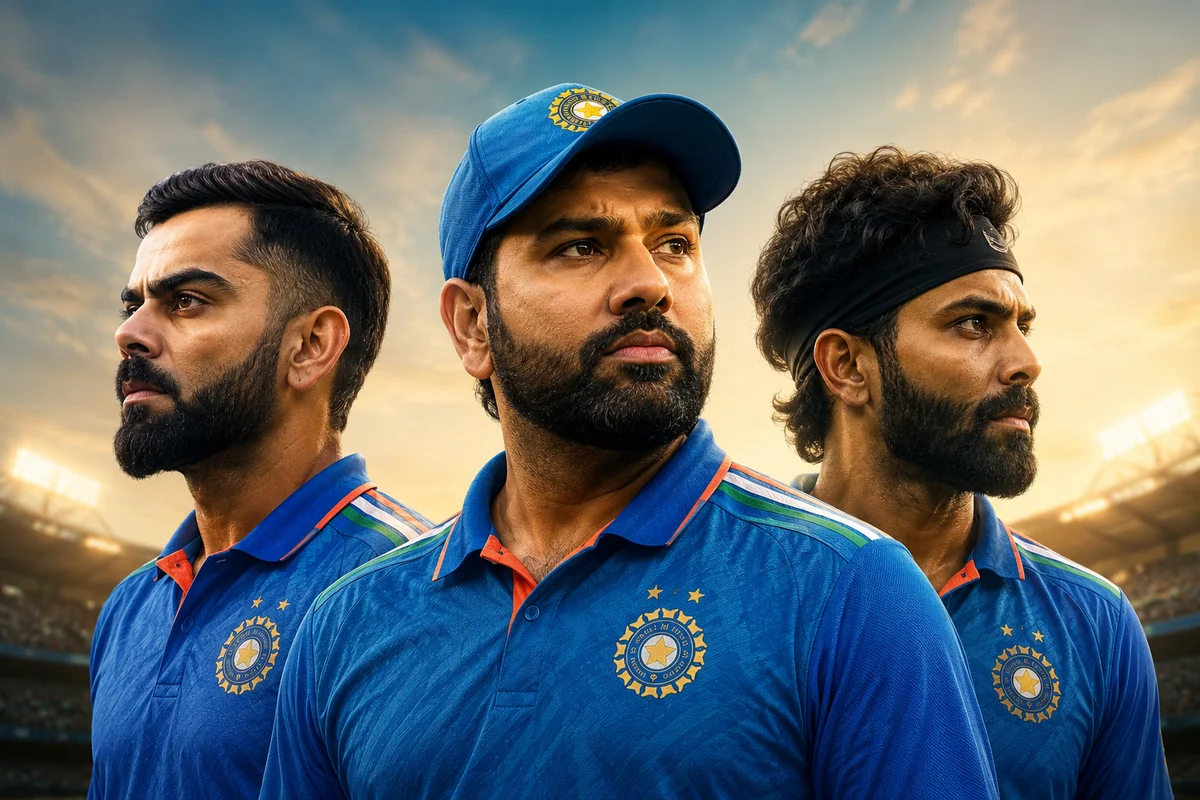
For more than a decade, India's one-day side has been built around three names: Rohit Sharma, Virat Kohli and Ravindra Jadeja. Between them, they have won ICC trophies, dominated bilateral series and rewritten record books, carrying Indian cricket through one of its most successful stretches. But every golden era eventually runs into the same uncomfortable question — when does a team start planning for what comes next?
That question has stopped being abstract. Ravindra Jadeja has already been left out of India's squad for the ongoing three-match ODI series in England, with chief selector Ajit Agarkar saying the panel wants to assess its options with roughly 15 months left before the 2027 World Cup. Rohit Sharma remains in the side, but has managed just 11 and 26 in the first two matches — form that has fuelled media speculation over his long-term ODI future. None of that has been confirmed by Rohit or the BCCI. What is confirmed is this: the series is tied 1-1, the third and final match is at Lord's on July 19, and Indian cricket is about to learn a great deal more about where this generation actually stands.
An Extraordinary Trio
It helps to remember just how rare this combination has been. Rohit Sharma is arguably the finest ODI opener of his generation — well over 11,700 runs at an average close to 49, the only man with three ODI double hundreds, and the format's highest individual score of 264, made against Sri Lanka in Kolkata in 2014. He scored five centuries in the 2019 World Cup alone, still a record for a single edition, and has more World Cup hundreds than anyone in the tournament's history. Add a T20 World Cup title and a Champions Trophy won as captain, and few batters have changed the way ODI innings begin quite the way he has.
If Rohit transformed how innings start, Kohli transformed how they finish. His ODI numbers are close to unmatched — nearly 14,800 runs at an average around 58.7, built on a record 54 centuries, the most by any batter in the format's history. His defining chapter came at the 2023 World Cup on home soil, where he scored 765 runs in eleven innings at an average of 95.63, the most by any player in a single World Cup edition, and walked away with the Player of the Tournament award even though India lost the final to Australia. His ability to absorb pressure and his fitness standards have made him one of the format's all-time greats, and India still leans on his experience whenever a match tightens — as this very series has shown, with Kohli responding to a five-run failure in the opener with a record-breaking 65 in Cardiff.
Jadeja's contribution is harder to reduce to numbers, though his are considerable too — 210 ODIs, close to 2,900 runs and something close to 230 wickets, built on a rare package of left-arm spin, lower-order hitting and fielding that regularly turns games. Very few all-rounders in world cricket can match that balance, and in ICC tournaments especially, he's often been India's quietest match-winner — a mainstay of India's World Cup squads in 2015, 2019 and the 2023 final.
Why This Debate Is Happening Now
Age remains part of the story. By the time the 2027 World Cup begins in South Africa, Zimbabwe and Namibia on October 4, Rohit will already be 40 — bidding to become the first player of that age to appear at a World Cup for India — while Kohli and Jadeja will both be 38. Planning around that is a normal part of a selector's job, and it doesn't automatically mean senior players get dropped. But this time it isn't only planning. Jadeja is already out of the squad for this series, and the reasoning selectors have given is instructive: Reports indicate that the selectors are using the period before the 2027 World Cup to assess different all-round options, particularly with South African conditions in mind. With players such as Axar Patel and Washington Sundar already in contention, the selection panel appears to be evaluating the balance of India's all-round resources rather than relying solely on past achievements. Young all-rounders such as Harsh Dubey are also emerging as long-term options, reflecting India's broader effort to build bench strength ahead of the 2027 World Cup.
It isn't purely an age call, either. Jadeja's own recent numbers make the case as much as his birth certificate does — he went wicketless across three ODIs against New Zealand earlier this year while conceding at more than six an over, and hasn't reached an ODI fifty since 2020. Judged by the standard this piece keeps returning to — current form over reputation — his exclusion is at least defensible on its own terms, whatever the optics.
Rohit's situation is murkier, and more live. India's batting coach, Sitanshu Kotak, has publicly defended him after both low scores this series, arguing that a player of his stature doesn't need to feel pressure over one or two failures, and pointing to conditions — double bounce, uneven carry — as much as form. That is the official line.
Unofficially, several Indian media reports have claimed that the senior selection committee discussed Rohit Sharma's long-term ODI future with head coach Gautam Gambhir and may no longer view him as part of India's plans for the 2027 World Cup. However, neither the BCCI nor Rohit Sharma has officially confirmed those reports. Meanwhile, youngsters such as Yashasvi Jaiswal continue to strengthen their case for a longer run at the top of the order. If those reports are accurate, Sunday's match at Lord's would be Rohit's last in India colours. If they aren't, it is simply a series decider that a struggling great needs to get right. Both versions are being reported. Only one of them has actually been confirmed, and it is neither: nothing has come from Rohit or the BCCI directly.
Age, in any case, may not be the decisive factor everyone assumes it is. Cricket has a long list of players who were still at their best deep into their late thirties — Kumar Sangakkara, Misbah-ul-Haq, Michael Hussey, Chris Gayle, even MS Dhoni in the shortest format. Years played has never reliably predicted decline; form always has. Kohli is the clearest illustration inside this very series — after failing in the first ODI, he answered with a fifty in Cardiff that broke three separate records in a single afternoon. Rohit's response at Lord's may end up mattering more to this debate than anything a selector says beforehand.
Youth Is Not the Same as Readiness
Whenever a senior player struggles, the same line gets repeated — it's time to give the youngsters a chance. It sounds reasonable enough on the surface, but rebuilding a team and simply replacing its senior players aren't the same exercise. The real question isn't whether India has promising young cricketers; it clearly does. It's whether those players are already good enough to step into a World Cup XI in Rohit's, Kohli's or Jadeja's place. That's a much harder question to answer honestly.
One common mistake in this conversation is treating IPL form as a reliable stand-in for ODI ability. The two formats ask for different things. T20 cricket rewards batters who attack from the first ball across 20 overs; ODI cricket asks a batter to build an innings across 120 to 150 deliveries, rotate strike, read conditions and construct partnerships. Plenty of players who dominated the IPL took years to find their feet in ODI cricket, because temperament matters just as much as talent — sometimes more.
None of this is a knock on India's young core, which is genuinely exciting — Jaiswal, Shubman Gill, Tilak Varma, Riyan Parag, Nitish Kumar Reddy, Harshit Rana, Harsh Dubey and Arshdeep Singh all look like part of the team's future, and several of them are no longer hypothetical options but players already inside the squad room. What's happening in this England series looks less like a vague rotation policy and more like the early stages of an actual handover: younger players being tried in specific roles — Jaiswal in the top order, Dubey and Sundar competing for the all-rounder's slot — while more experienced campaigners are still given the chance to hold their places on current form.
Experience is hard to substitute for in exactly the moments that decide World Cups. Think back to India's biggest ICC knockouts — the players who absorbed pressure, managed tricky chases and knew when to attack or hold back were, more often than not, the experienced ones. That kind of composure isn't something domestic cricket teaches; it's learned by playing international cricket with real stakes attached, which is why most World Cup-winning sides have leaned on senior players rather than fielding entirely new cores.
Australia's approach is a useful comparison here. Australian selectors have a reputation for being ruthless, but they rarely remove all their senior players at once — instead, they bring younger cricketers in gradually while keeping experienced leaders around them, which gives newcomers confidence without asking them to carry the whole team alone. India appears to be facing a version of the same choice, and the current squad suggests it has, for now, chosen the gradual route: one senior all-rounder eased out, two senior batters still in the XI on the strength of what they've done for the team, not just who they are.
And the conversation inside Indian cricket doesn't actually read as a simple "old versus young" fight, either. Captain Shubman Gill has said publicly that Rohit Sharma and Kohli remain important to the team's long-term ODI plans, even as Agarkar frames the Jadeja decision as pragmatic rather than punitive. That's a fairly clear signal that this is about finding balance rather than forcing a binary choice.
If there's a sensible way to think about selection here, age shouldn't be the first filter applied. The first questions should be simpler: is the player scoring runs, are they fit, can they still win matches, and is there someone clearly better ready to take their place? Only after those questions are answered should age enter the conversation — which is roughly how the strongest teams in world cricket tend to approach these calls, and roughly how India appears to have approached Jadeja's case specifically.
The risk cuts both ways. Drop too many experienced players at once, and India could walk into 2027 with plenty of talent but almost no experience of handling knockout pressure. Hold the next generation back too long, and the team risks being caught unprepared once this core does eventually retire. Avoiding both extremes — rather than picking a side between youth and experience — is the actual challenge in front of the selectors.
A Question Bigger Than One Series
Every generation of Indian cricket eventually arrives at this same crossroads. Sachin Tendulkar's era ended. Rahul Dravid and VVS Laxman retired. MS Dhoni stepped away. Now it's Rohit Sharma, Kohli and Jadeja's turn to face the same reckoning, and this time it isn't only about who plays the next World Cup — it's about the direction Indian cricket takes over the next decade.
A World Cup is not the place to experiment. Bilateral series exist for testing combinations; World Cups are where teams trust the players who have earned that trust. Every serious cricketing nation understands this — Australia and England have both built squads this way, and India managed the same balance successfully back in 2011, when a veteran core of Tendulkar, Sehwag and Dhoni carried the campaign while a much younger Kohli, playing in his first World Cup, contributed a composed innings in the final alongside Gautam Gambhir before Dhoni finished the job. Young players bring energy, experienced ones bring composure under pressure, and the teams that actually win World Cups tend to have both in the room together.
If selectors do eventually move on from Rohit Sharma, the question they need to answer isn't whether someone younger is available — it's whether someone is clearly better right now. Jaiswal's early ODI form suggests he might be, but six innings is six innings, not a season. The same standard should apply to Jadeja: is there an all-rounder who can bowl ten overs, finish an innings with the bat, save fifteen to twenty runs in the field and deliver in ICC knockouts, all at once? Selectors are effectively betting that Axar Patel, Washington Sundar or Harsh Dubey can grow into that role in time for South Africa. Replacing a player of Jadeja's calibre was never about finding potential. It's about finding someone who can already do the job — or backing someone to get there within fifteen months.
Form has to matter more than reputation. Legends can't play forever, but they shouldn't be pushed out simply because of their age either. Selection should rest on three things — current form, fitness and match-winning ability — and that standard should apply equally whether a player is 22 or 39. If a senior player truly isn't performing anymore, selectors need to move on. If he's still among India's best, age by itself shouldn't be the reason he's left out.
There's a risk on the other side of this debate too, and it deserves just as much attention. Indian fans often judge young players on the strength of one good IPL season, but international ODI cricket is a different test altogether — the pressure, the conditions and the expectations all change. Plenty of talented cricketers need real time before they become dependable at this level, and pushing an inexperienced core into a World Cup without enough preparation would be its own kind of gamble.
Our View
This conversation needs to move past emotion, whichever side of the debate you're on. It isn't about protecting legends out of sentiment, and it isn't about clearing them out as quickly as possible either — it's about picking India's strongest possible ODI team. Jadeja's exclusion from this squad looks, on the evidence, like a defensible cricketing call rather than a symbolic one. Rohit's case is genuinely open, and Sunday will tell selectors more than any meeting did: if he finds his form at Lord's, in a decider, in the format he has dominated for most of two decades, he will have made his own argument better than anyone else could make it for him. If he doesn't, the selectors' reported thinking will look less like an ambush and more like a call that was probably coming anyway. Either way, competition should decide the squad, not reputation — and, to their credit, that appears closer to what is actually happening than the more dramatic version of this story suggests.
The one mistake Indian cricket cannot afford is picking a side — going all in on youth, or clinging entirely to experience. History rarely rewards either extreme; the strongest World Cup squads are almost always built on balance. The version of India's 2027 squad most likely to succeed in South Africa probably looks like a handful of proven match-winners, a new generation already earning minutes in exactly these conditions, and a leadership group under Shubman Gill that pairs experience with fearless cricket. That balance, more than age, will likely decide whether India lifts another ODI World Cup.
Until the BCCI makes an actual call, Rohit Sharma's ODI future remains speculation, however widely reported and however carefully sourced. What isn't speculation is Sunday's match at Lord's, where a 39-year-old with almost nothing left to prove will try to answer, in the only language selectors have ever really trusted, a question no meeting or press conference can settle for him.
Editor's Note: This editorial reflects verified public information available at the time of publication. References to Rohit Sharma's future are based on media reports unless officially confirmed by the BCCI or the player himself.
Latest News
- Kudankulam Nuclear Plant Data Leak: India Launches Probe
- EU Deepens Ukraine Defence Partnership Amid Russian Threat
- Has India's Diplomatic Momentum Slowed? Pakistan's Iran Deal Role Raises Questions
- DuckDuckGo 'No AI' Traffic Triples After Google I/O
- Twin Earthquakes Strike Venezuela, Killing 32 and Injuring Around 700
- US Waives Iran Sanctions 60 Days; Trump Warns on Compliance
- UK PM Keir Starmer Resigns, Andy Burnham Set to Replace
- Nobel Laureate John Jumper Leaves DeepMind for Anthropic
- UAE Bans Social Media for Under-15s in New Child Safety Law
- India Blocks Telegram Until June 22 Amid NEET-UG 2026 Re-Exam Fraud Fears