UPI to Remain Free for Consumers and Small Merchants, PCI and PhonePe's Nigam Clarify Amid MDR Debate
New Delhi, August 8, 2026 — UPI payments will continue to be free for consumers, while small merchants such as neighbourhood kirana stores will not be required to pay Merchant Discount Rate (MDR) charges, according to the Payments Council of India (PCI). PhonePe founder and CEO Sameer Nigam has separately reiterated that consumers will not be charged for UPI payments, seeking to quell concerns following the Lok Sabha's passage of legislation that could enable merchant-side charges on certain digital payments.
The clarification follows the Lok Sabha's passage of the Taxation and Other Laws (Amendment) Bill, 2026, which proposes amendments to the Payment and Settlement Systems Act, 2007. The proposed changes would remove the existing legal restriction on charging for certain electronic payment transactions and provide a basis for the government to permit such charges through future notifications.
"UPI is and will remain free for all Indian consumers!" Nigam said in a post on X on Saturday.
He added that users would not be charged for making UPI transactions. His comments came a day after the PCI issued a clarification that UPI transactions would remain free for consumers and that small merchants would not face charges for accepting UPI payments.
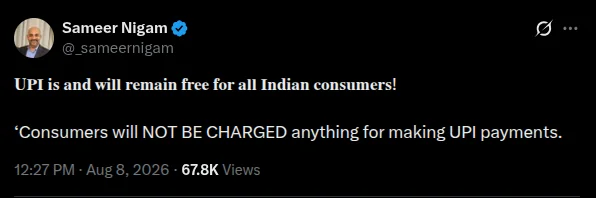
in a post on X on August 8, 2026.
Screenshot: X / @sameernigam
The Bill does not introduce an immediate UPI transaction fee for consumers. Instead, if enacted, it would create a legal basis for the government to permit charges, including MDR, on notified electronic payment modes. The exact categories, rates and implementation mechanism would depend on subsequent government notifications and regulations.
MDR is a fee associated with processing a merchant payment and is generally a merchant-side charge rather than a direct transaction fee imposed on the consumer. Earlier reports have cited different possible MDR structures, including a rate of around 0.25% to 0.4% on certain business-directed UPI transactions above ₹2,000. However, these figures are not specified in the Bill, and no final MDR framework has been notified.
The PCI has said small businesses, including neighbourhood kirana stores, will not be required to pay MDR charges for accepting UPI payments. Any merchant service charges that may eventually apply to eligible businesses would be part of commercial arrangements between merchants and payment service providers, rather than a fee automatically imposed on consumers whenever they use UPI. The distinction is significant for India's small-business economy, where UPI has become a major payment method for everyday purchases.
UPI has largely operated without MDR being charged to merchants for standard bank-account transactions, while consumers have not been charged a transaction fee for ordinary UPI payments. This model helped accelerate digital-payment adoption across India, while banks, payment service providers and fintech companies have continued to bear the costs associated with maintaining payment infrastructure, cybersecurity, fraud prevention and other services. If merchant-side charges are eventually permitted for eligible transactions, they could create an additional revenue stream for banks and payment service providers while keeping ordinary consumer UPI payments free. The proposal is part of a broader debate over how India's rapidly expanding digital-payments infrastructure should be funded sustainably.
For the average consumer, there is no immediate transaction fee arising from the Bill. PCI and PhonePe have both said consumers will continue to be able to use UPI without a transaction charge. The current debate is instead focused on whether certain higher-value, business-directed transactions could eventually attract merchant-side MDR, meaning claims that the government has already introduced UPI charges for everyone would be misleading.
Since its launch in 2016, UPI has transformed India's digital-payments landscape, enabling instant bank-to-bank transfers through mobile applications. The platform has grown rapidly over the past decade: in July 2026 alone, UPI processed 23.66 billion transactions worth approximately ₹29.88 lakh crore, according to NPCI data, while the system recorded 24,162 crore transactions worth ₹314 lakh crore over the 2025–26 financial year, according to government data cited in Parliament. The proposed changes underline a broader policy question: how India can preserve UPI's low-cost and inclusive model while ensuring that banks, payment companies and other participants have sustainable economics to maintain and expand the country's digital-payments infrastructure.
The immediate question is not whether consumers will start paying for UPI, but whether — and how — MDR will eventually be introduced for selected business transactions. The Bill, if enacted, would provide a legal basis for the government to permit such charges on notified electronic payment modes, and the precise categories, rates and implementation mechanism would determine how any future MDR regime affects large merchants, banks and payment service providers.
For now, PCI and PhonePe have said that consumers will not be charged for UPI payments, while PCI has said small merchants will not be required to pay MDR. The Lok Sabha's passage of the Bill therefore represents a potential change in the regulatory framework for digital-payment charges — not the introduction of a universal UPI fee today.
Latest News
- US Senate Russia Sanctions Bill: India Faces 100% Tariff Threat
- Moonshot's Kimi K3 Breaks Out of Security Sandbox
- Parliament Protest: Ram Temple Donations, Student Crackdown
- Palestine Land Changes: A Century of Change
- CBI Files FIR Against Anil Ambani Over ₹1,816 Cr EPFO Loss
- New Zealand Introduces English Official Language Bill
- Israeli Strikes Kill 6 in Gaza Amid Cairo Talks
- AISA Says NEET Protest Will Continue, Seeks Release of Students
- Bombay High Court Grants Nitin Gadkari Leave to Sue Meta, X, Google
- Delhi Transporters Announce August 4 Parliament March Over E20 Petrol