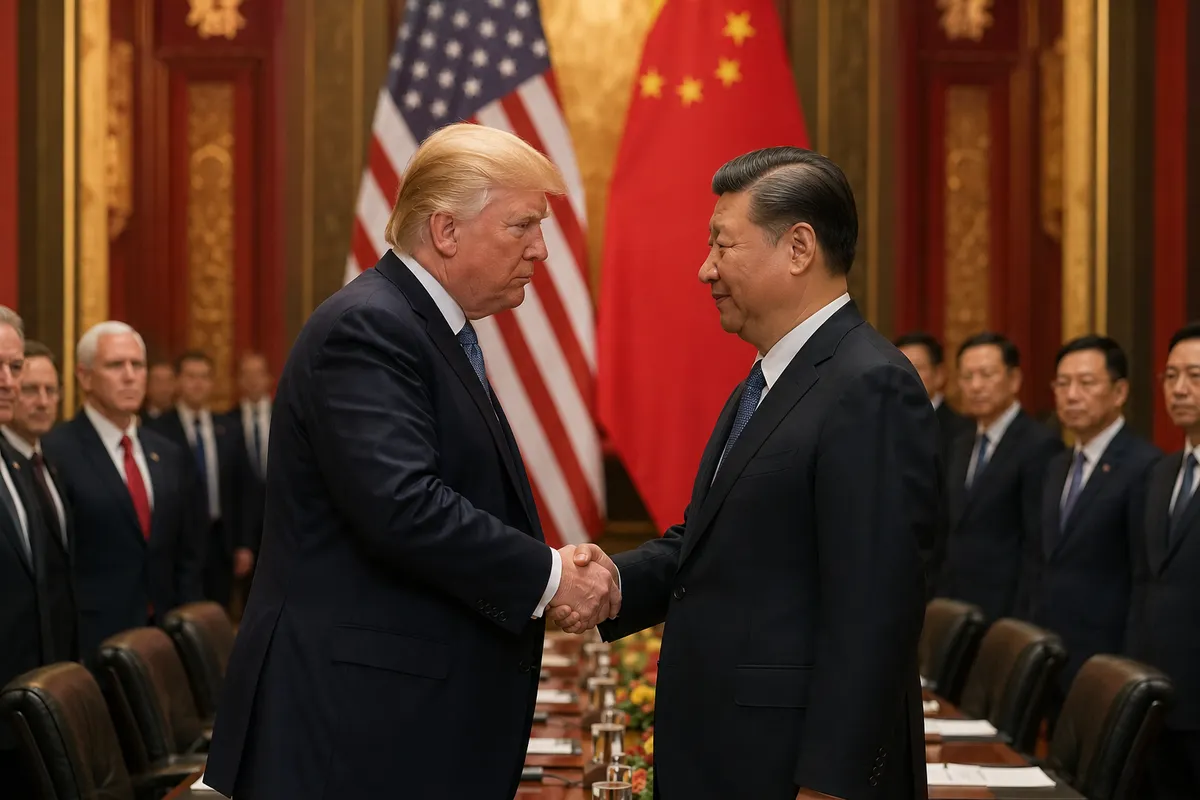
BEIJING, May 15, 2026 — President Donald Trump departed Beijing on Friday after two days of talks with Chinese President Xi Jinping that produced a set of concrete commercial agreements and a joint statement on Middle East energy security, but left unresolved the deeper disputes over Taiwan, advanced semiconductors, and the structural shape of the two countries' economic competition.
The visit, which ran from Wednesday evening through Friday morning, was the first by a sitting American president since Trump's own trip to China in November 2017. It came after months of preparation, a delay caused by the outbreak of U.S.-Israeli military operations against Iran in late February, and a preliminary round of negotiations in Seoul between U.S. Treasury Secretary Scott Bessent and Chinese Vice Premier He Lifeng.
The two leaders agreed to develop what Beijing described as a "constructive China-U.S. relationship of strategic stability," according to China's official readout of the summit. Xi said Beijing would treat this as the guiding framework for the next three years and beyond.
The White House readout was narrower in scope. It said Trump and Xi had "a good meeting" focused on enhancing economic cooperation, and that the two sides agreed on several specific deliverables, including expanded Chinese purchases of U.S. agricultural products and a mutual position that the Strait of Hormuz must remain open and free of tolls. Xi also expressed interest in increasing Chinese purchases of American oil, according to a White House official who briefed reporters on condition of anonymity.
Trump, speaking to Fox News anchor Sean Hannity on Thursday evening from Beijing, described Xi's pledge on Iran in direct terms. "He said he's not going to give them military equipment. That's a big statement. He said that today," Trump told Hannity, adding that Xi "said that strongly." Trump also said Xi told him he wanted to see the Strait of Hormuz reopened, and recounted the Chinese leader's description of the situation: "He joked, he said, 'you know, they stopped it, then you stopped them.'"
China's foreign ministry readout made no mention of Iran, saying only that the two leaders had exchanged views on "major international and regional issues."
The gap between the two official accounts was typical of the summit overall. Both governments signaled progress while leaving themselves room to interpret specific commitments on their own terms.
On Taiwan, Xi was unambiguous in the closed-door sessions. Xi warned Trump that the U.S. and China "will have clashes and even conflicts" if the issue of Taiwan's independence is mishandled. Xi called Taiwan "the most important issue in China-US relations" and said it could create "a very dangerous situation" if handled incorrectly. Xi also pressed Trump to formally state that Washington "opposes" Taiwanese independence — a stronger position than the longstanding U.S. policy of not "supporting" it.
Trump did not answer a reporter's question on Taiwan while standing next to Xi. Secretary of State Marco Rubio said afterward that U.S. policy on Taiwan remains unchanged. The $11 billion arms package the administration approved for Taiwan in December 2025 — the catalyst for much of Beijing's frustration — has not yet been delivered and remains in bureaucratic limbo.
Taiwan's government, in a statement issued Thursday, described China as the "sole risk" to regional peace and stability.
The business dimension of the visit was unusually prominent. Trump arrived with a delegation that included Apple CEO Tim Cook, Tesla's Elon Musk, Nvidia's Jensen Huang, BlackRock Chairman Larry Fink, Goldman Sachs CEO David Solomon, and executives from Boeing, Cargill, Qualcomm, and Citigroup, among others. Chinese Premier Li Qiang met separately with the American executives and expressed hope that they would "further strengthen the ties of mutually beneficial cooperation between China and the US, and continue serving as bridges for communication and dialogue between the two countries," according to a readout from the state-run Xinhua news agency.
Huang's inclusion in the delegation was arranged at the last minute. He boarded Air Force One during a refueling stop in Anchorage, Alaska, after a direct call from Trump. The urgency was tied to a frozen semiconductor transaction: the U.S. Commerce Department had approved sales of Nvidia's H200 AI chips to roughly ten major Chinese technology companies, including Alibaba, Tencent, ByteDance, and JD.com — up to 75,000 units each — but no shipments had moved. Chinese authorities had instructed domestic firms to pause procurement while conducting a supply-chain review focused on reducing dependence on American chip architecture.
The Beijing sessions did not break that deadlock. China's push to develop indigenous alternatives through companies like Huawei continues regardless of export approvals from Washington.
Xi told the assembled American business leaders that China's door to international business "will only open wider," and pointed to Tesla's integration with Chinese suppliers as a model for future cooperation. Whether that rhetoric translates into changed regulatory conditions for the companies in the room remains to be seen.
The summit also advanced two institutional structures that had been in development since earlier this year. The first, a "Board of Trade," would function as a standing bilateral body to manage purchasing commitments and reduce tariffs on non-strategic goods — roughly $30 billion worth, according to people familiar with the discussions. The second, a "Board of Investment," is intended to streamline Chinese capital into non-sensitive American industries without requiring a full review by the Committee on Foreign Investment in the United States, a process that has contributed to a collapse in Chinese direct investment in the U.S. from a peak of $56 billion in 2016 to under $4 billion last year.
According to analysts at the Council on Foreign Relations, China's aim entering the summit was to buy more time to consolidate its technological and industrial position and reignite its faltering economy, while the U.S. aim was to secure symbolic wins rather than meaningful structural reforms to China's economic model. Beijing was "probably willing to buy Boeing aircraft and American soybeans for stability, and to announce the Board of Trade and parallel Board of Investment already sketched out in previous working-level talks."
The agricultural commitments align with that assessment. Beijing renewed hundreds of licenses for U.S. beef exporters and pledged large-scale soybean purchases, addressing an agricultural lockout that had weighed on American farming communities for much of 2025. A prospective order of 500 Boeing aircraft was also advanced in the talks.
Trump arrived in Beijing seeking headline deals and visible momentum ahead of the midterm elections. Xi, analysts noted, was playing a longer game, focused on strategic patience rather than substantive compromise.
The summit's broader backdrop was shaped heavily by the Iran conflict. The war, which began with U.S. and Israeli strikes in late February, has driven oil prices above $112 per barrel and created a dual blockade of the Strait of Hormuz. Defense Secretary Pete Hegseth had announced in April that Beijing had provided high-level assurances to the White House that it would not send weapons to Iran, including surface-to-air missiles, which he attributed to the "strong and direct relationship" between Trump and Xi.
Rubio told reporters that the U.S. was not seeking China's assistance in ending the conflict, a statement that sat in some tension with Trump's public account of the Hormuz discussion.
Trump extended a formal invitation to Xi to visit Washington on September 24. Both leaders are expected to meet again at APEC in Shenzhen in November and at the G20 in Miami in December.
Hours after Trump's departure, the Kremlin announced that Russian President Vladimir Putin would make a state visit to China "in the near future." The timing was noted by several Western diplomats, though it was not characterized as a direct response to the summit.