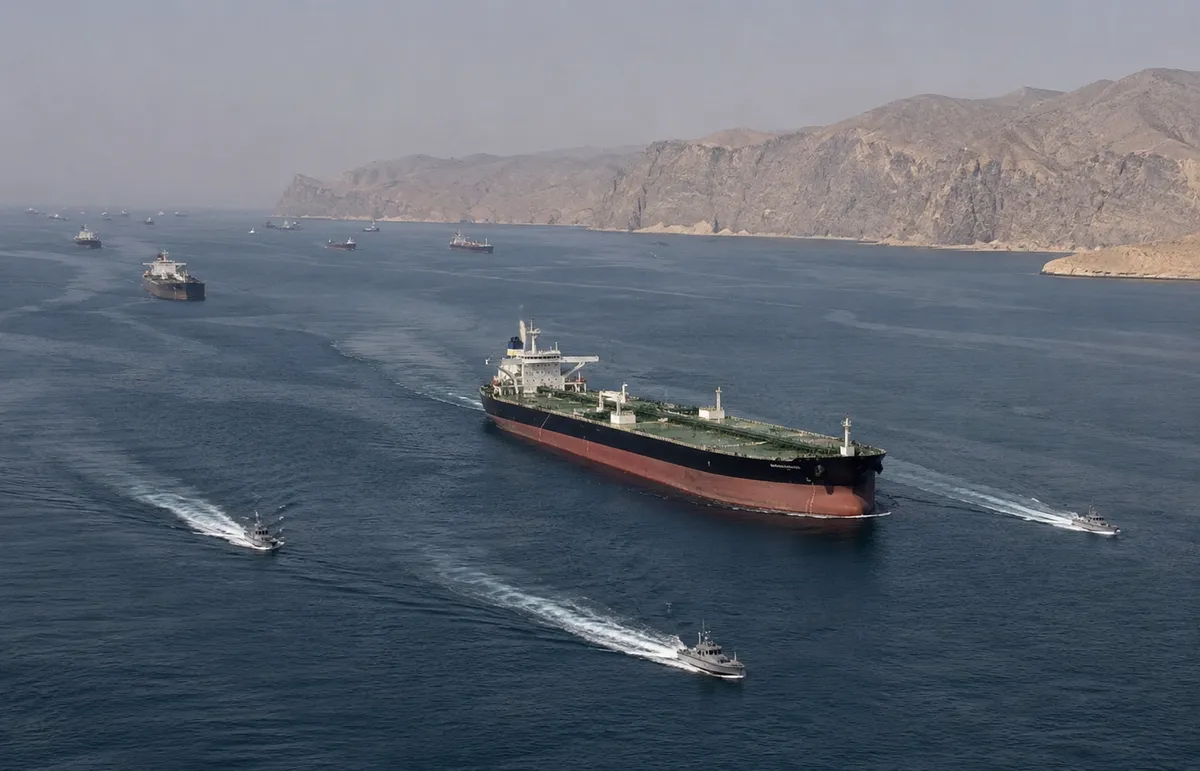
UNITED NATIONS, New York — The Strait of Hormuz is not the kind of place that makes headlines on a quiet Tuesday. For most people, it doesn't exist at all — it's just somewhere oil comes from, somewhere far away, somebody else's problem. Until it isn't.
This year, it isn't.
Wedged between Iran and Oman, the Strait is barely 21 miles wide at its narrowest point. But through that tight corridor moves roughly one-fifth of the world's entire oil supply — every single day. Saudi crude, Qatari gas, Emirati oil, Kuwaiti exports — all of it funnels through Hormuz before it reaches the tankers that carry it to Asia, Europe, and beyond. There is no alternate route. There is no Plan B. If Hormuz closes, the world feels it within days.
Right now, the world is getting nervous.
Against the backdrop of a military crisis that has been building for months — involving Iran, the US, Israel, and several Gulf nations — Bahrain has walked into the United Nations and put a resolution on the table. The demand is straightforward: Iran must stop attacking Gulf states and international shipping, and the Strait of Hormuz must remain open to all.
What happened next surprised even some veteran diplomats. Within weeks, 112 countries had signed on.
That is not a small number. That is not a coordinated PR exercise. That is governments from every corner of the world quietly deciding that this particular crisis has gotten serious enough to put their name on a piece of paper at the UN.
Bahrain is an unusual country to be leading this charge. It's a small island nation — most people couldn't find it on a map without help. But it hosts the US Navy's Fifth Fleet, it sits right in the middle of Gulf politics, and when it comes to maritime security, it has spent decades building credibility. When Bahrain raises its hand at the UN, Washington listens. So does Riyadh. So does Brussels.
The resolution it's pushing doesn't ask for anything dramatic. No military authorization. No sanctions. It asks for freedom of navigation, safe passage for civilian ships, protection of maritime crews, and a step back from the military brinkmanship that has made the Gulf so volatile. Diplomats say the careful, measured language was entirely deliberate — broad enough to attract support, specific enough to actually mean something.
The situation that made this resolution necessary didn't happen overnight.
Through 2025 and into 2026, the Gulf slowly turned into something resembling a war zone for commercial shipping. Missile and drone attacks increased. Ships were boarded, threatened, and in some cases chased. Insurance companies started treating tankers bound for the Gulf the way they treat planes flying into active conflict zones — premiums went through the roof, and smaller shipping operators simply stopped going. Naval forces from multiple countries piled into the same waters, each watching the others, nobody backing down.
Western governments and Gulf states blamed Iran and the groups it supports. Iran blamed the US and Israel for destabilizing the region in the first place. Neither side was entirely wrong. Neither side was entirely right. And while everyone argued, the attacks kept happening.
Tehran's reaction to the resolution was predictable, and it came fast.
Iranian officials called it a one-sided hit job — a document designed to put all the blame on Iran while pretending that American and Israeli military operations in the region simply don't exist. "Freedom of navigation cannot be used as cover for foreign military aggression near Iranian territory," one official said, in what was about as direct a warning as diplomatic language allows.
Iran has a point that its critics don't like to acknowledge — Western naval deployments in the Gulf are not exactly calming. But that argument has been running for years, and it hasn't stopped ships from being attacked. The world's patience is wearing thin.
Here is the part where this gets genuinely difficult.
The UN Security Council has five permanent members with veto power: the US, UK, France, Russia, and China. It only takes one veto to kill a resolution entirely, regardless of how many other countries support it. And right now, both Russia and China are eyeing this resolution like it's a trap.
China has too much invested in its relationship with Iran — economically, strategically — to be seen backing a resolution that Tehran is screaming about. Beijing doesn't want a confrontation with Iran, and it definitely doesn't want to be seen doing Washington's bidding at the UN. Russia's position is almost automatic at this point: if it looks like Western pressure on a non-NATO country, Russia votes no. It's that consistent.
Both countries are pushing for the language to be softened significantly. Negotiations are continuing. Nobody is saying publicly how they'll vote when the time comes.
If the resolution passes, it won't end the crisis. But it will matter. Iran would be staring at a near-unanimous international consensus telling it to stop. Naval operations in the Gulf could expand with broader legitimacy. Shipping companies might start sending their vessels back through. Oil markets — which have been quietly panicking for months — might breathe a little easier.
If it gets vetoed, the damage goes beyond just this resolution. A Security Council that can't agree on protecting one of the world's most critical shipping lanes is a Security Council that has serious problems. Western governments and Gulf states would almost certainly start building their own coalitions outside the UN framework. The Gulf would get more tense, not less. And oil markets, which despise uncertainty above all else, would react accordingly.
Some analysts have said it plainly: a failed vote at the UN doesn't just mean a diplomatic setback. It meaningfully increases the odds of something going wrong in the water — a confrontation, an incident, the kind of thing that escalates before anyone has time to think about it.
People sometimes ask why a maritime dispute in the Persian Gulf should matter to someone sitting in Tokyo, or Nairobi, or Mexico City.
The honest answer is that it already does.
Fuel prices don't go up in isolation. When oil gets more expensive to move, everything that depends on oil gets more expensive — which is most things. Food costs more to transport. Airline tickets go up. The price of making almost anything in a factory somewhere goes up. Energy bills for families who have never heard of the Strait of Hormuz go up.
That is the reality of how interconnected the global economy actually is. A crisis in a 21-mile-wide waterway between two countries most people can't name has the ability to make daily life harder for hundreds of millions of people who have absolutely no say in what happens there.
That's why 112 countries signed the resolution. That's why the veto question is being watched so closely. And that's why, in 2026, a narrow strip of water at the bottom of the Persian Gulf has become one of the most consequential geopolitical stories on the planet.
The Security Council vote is coming. Nobody knows which way it goes. But everyone, from oil traders in London to families filling up their cars in Jakarta, will feel the answer.