At the time of publication, no official Israeli authority has confirmed a nuclear incident, foreign strike, or casualties related to the explosion.
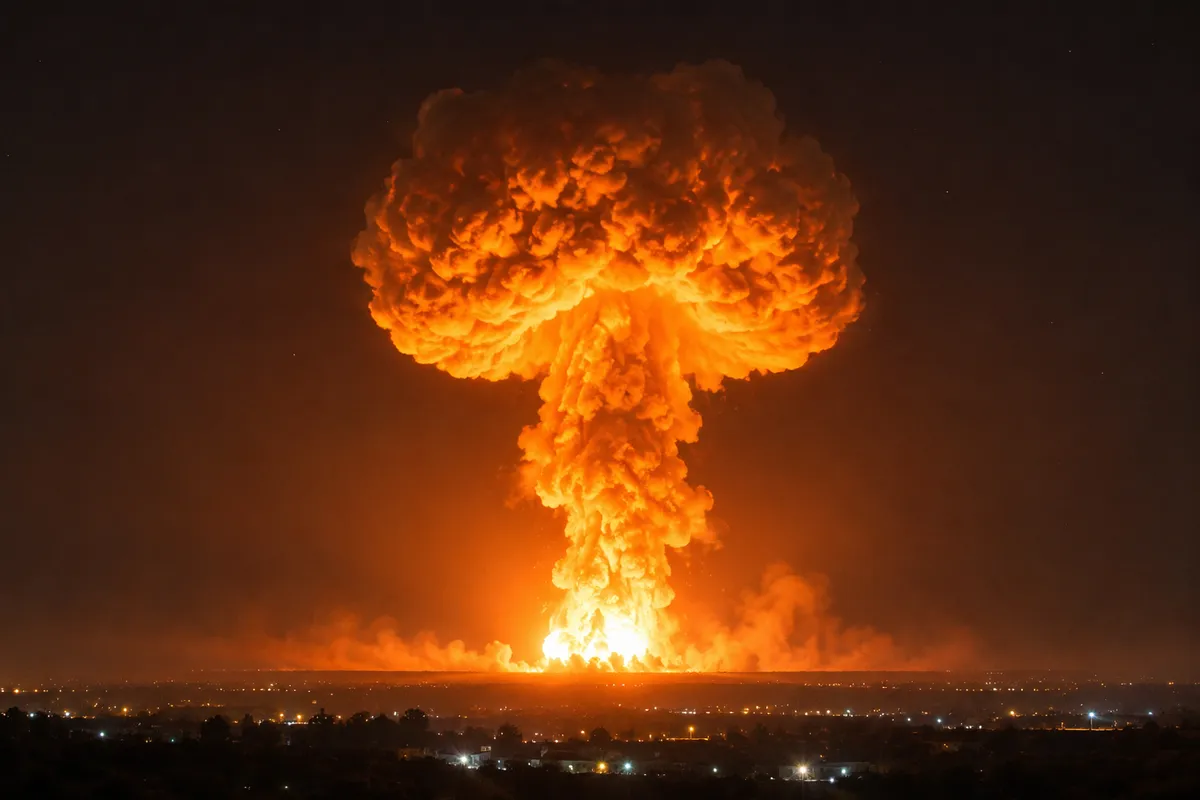
Late at night, somewhere in Israel, the sky turned orange. A thick column of fire shot upward, forming a mushroom-shaped plume that quickly drew attention online. Within hours, the footage was everywhere, shared across platforms by people who had questions and very few answers.
The explosion is believed to have occurred near a testing area linked to Tomer, an Israeli state-owned defense company that develops propulsion systems for some of the country's most advanced missile programs. Tomer is specifically known for its work on the Arrow-2 and Arrow-3 interceptor systems. The Arrow-3 is not a minor program — it is Israel's uppermost layer of missile defense, built to intercept ballistic missiles before they re-enter the atmosphere, and has become increasingly important given the regional security environment.
But here is what the evidence actually shows, as of now: nothing officially confirmed beyond the explosion itself.
No Israeli government body has declared a nuclear emergency. No casualties have been reported. No foreign attack has been acknowledged. The most straightforward explanation — that this was a propulsion or engine test that produced an unusually dramatic visual — has not been ruled out, and in fact aligns with what facilities like Tomer's are designed to do. Rocket propellant burns hot and fast, and under certain atmospheric conditions, the smoke it produces can billow into shapes that appear far more alarming than they are.
That did not stop social media from drawing its own conclusions. Posts claiming the blast occurred near a nuclear storage site circulated widely. Others suggested it was an Iranian strike or a deliberate sabotage operation. No verified evidence currently supports claims of an Iranian strike, sabotage operation, or any nuclear-related incident.
Israel maintains a long-standing policy of ambiguity around its defense and nuclear capabilities and rarely comments on anything touching those subjects. That silence, predictable as it is, tends to fuel exactly the kind of speculation that followed this explosion. When official sources say nothing, the internet fills the gap — and rarely with measured assessments.
What is clear is that the facility linked to Arrow-3 missile propulsion systems represents a genuinely significant part of Israel's defense infrastructure, developed in part through cooperation with the United States. Any confirmed incident near such a facility would carry real strategic weight. The problem is that right now, there is no confirmed incident — only circulating footage, an unverified location, and a story that moved faster than the facts behind it.
As the videos continue to spread, the situation remains what it was when the first clip appeared: unexplained, unverified, and more complicated than any single headline can capture.