Assam Assembly Passes Uniform Civil Code Bill 2026, First in Northeast India
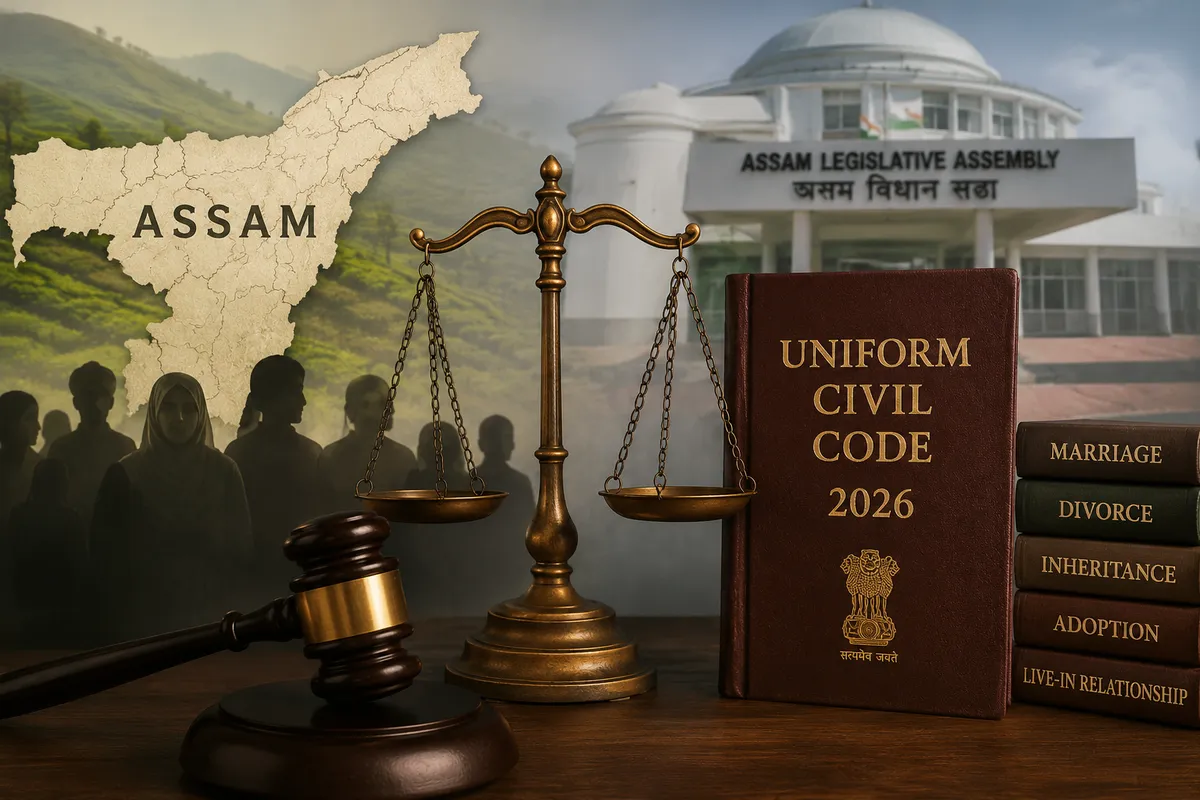
Guwahati, May 27, 2026 — The Assam Legislative Assembly on Wednesday passed the Uniform Civil Code (UCC) Bill 2026, making the state the first in Northeast India and one of the few across the country to enact a state-level uniform civil law framework.
The legislation, introduced by the BJP-led state government, establishes a common set of civil laws governing marriage, divorce, inheritance, adoption, and live-in relationships — applicable across religious communities, with a specific exemption for Scheduled Tribes.
Key Provisions of the Bill
Ban on Polygamy and Bigamy
The bill prohibits polygamy and bigamy for all persons covered under the UCC. Violations are liable to be prosecuted under the Bharatiya Nyaya Sanhita (BNS), 2023. Marriages solemnized prior to the law's commencement are expected to remain legally protected.
Mandatory Registration of Marriages and Divorces
All marriages and divorces must now be officially registered within a prescribed period. Unregistered unions may not receive legal recognition under the new framework.
Registration of Live-in Relationships
The bill makes registration of live-in relationships compulsory. Children born from such relationships will be granted legal legitimacy, and partners will be entitled to maintenance rights under the law.
Equal Inheritance Rights
The legislation introduces uniform inheritance provisions, granting sons and daughters equal property rights irrespective of their religion.
Uniform Grounds for Divorce
Grounds such as cruelty, desertion, and mutual consent will now apply uniformly across all communities, replacing religion-specific personal law provisions in these matters.
Minimum Age for Marriage
The law retains the existing minimum age for marriage — 21 years for men and 18 years for women.
Scheduled Tribes Exempted
Chief Minister Himanta Biswa Sarma stated that the legislation will not apply to Scheduled Tribes residing in Assam. Indigenous customs, rituals, and traditional practices of tribal communities will remain outside the purview of the UCC.
Opposition Raises Objections
Opposition parties strongly contested the bill on the floor of the Assembly, demanding that it be referred to a Select Committee for detailed legislative review before being put to a vote. The government rejected the demand, and the bill was passed following debate.
Opposition members raised concerns about the law's applicability in a state with significant cultural, religious, and ethnic diversity. Critics contend that certain community-specific personal law traditions may be affected by the legislation's uniform provisions.
Proponents of the bill argue that it advances gender equality — particularly for women — by standardizing civil rights and protections that were previously uneven across different personal law systems.
Political and Legal Context
Assam joins Uttarakhand and Gujarat as among the few Indian states to have moved ahead with a state-level UCC framework. The passage of this bill is expected to contribute to the broader national conversation around the implementation of a Uniform Civil Code at the central level.
The law is yet to be notified for implementation. Further procedural and administrative details are anticipated to follow in the coming weeks.
Latest News
- Drone Crashes Near Itamar Ben-Gvir's Residence in Hebron
- From Students to a Nationwide Movement: The CJP Protest Explained
- Ukraine Claims Russia Preparing to Deploy 30,000 North Korean Troops
- UK Inquest Rules Saudi Prince's Death a Misadventure in London
- Muzaffarnagar Girl Dies by Suicide After School Humiliation
- Supreme Court Restricts Sharing of Court Hearing Recordings
- 19-Year-Old Protester May Lose Vision After Alleged Pellet Injury
- Supreme Court Declines Urgent Hearing on Student Protest Plea
- 10 Dead, 15 Trapped in Sikkim NHPC Tunnel Blast
- Media Propaganda: How It Shapes Public Opinion