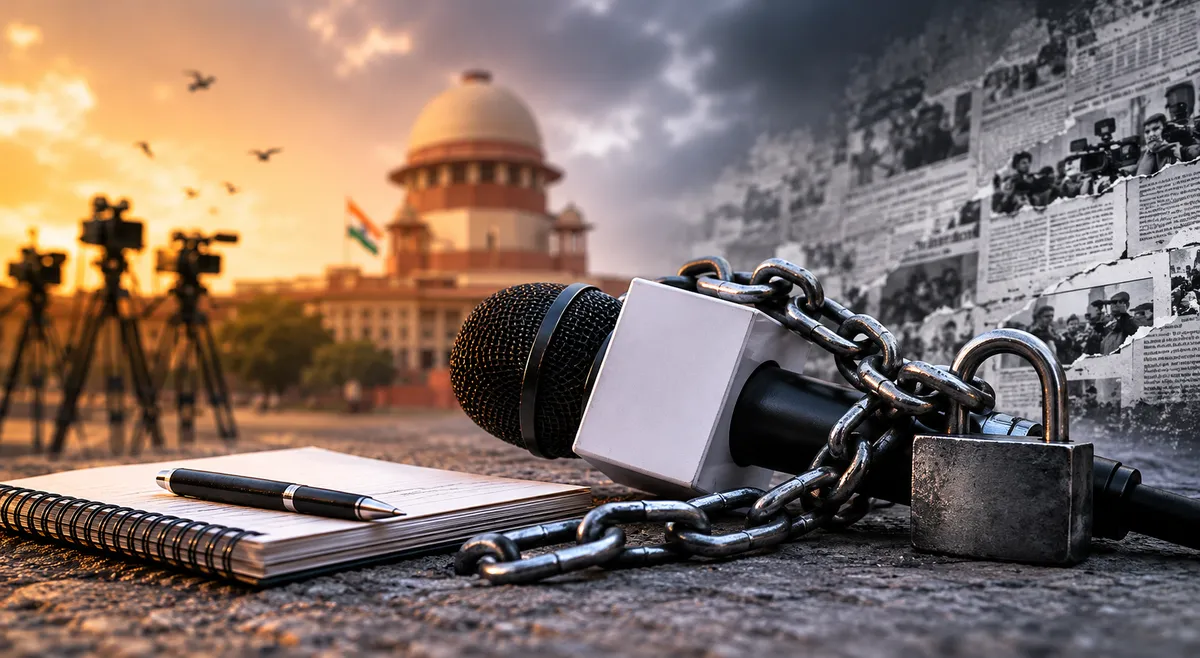
NEW DELHI — India ranked 157th out of 180 countries in the 2026 World Press Freedom Index, according to the Paris-based organization Reporters Without Borders (RSF), extending a decade-long decline that has carried the world's most populous democracy from a challenging but functional media environment into what the index classifies as a "very serious" situation for journalism.
The 2026 report, published annually by RSF under its French name Reporters Sans Frontières, arrived against a backdrop of historic global deterioration. Press freedom has fallen to its lowest level in 25 years, the organization says, with more than half of the 180 evaluated countries now rated "difficult" or "very serious." In 2002, roughly 20 percent of the world's population lived in countries where press freedom was classified as "good." By 2026, that figure has collapsed to under one percent.
For India, the numbers tell a sharper story. The country ranked 133rd in 2016 with a score of 43.17. By 2026, its score had declined to 31.96, placing it below Pakistan (153rd), Bangladesh (152nd), Bhutan (150th), Sri Lanka (134th), the Maldives (108th), and Nepal (87th) within South Asia.
A Decade of Decline
India's slide in the index was gradual at first. The country moved from 133rd in 2016 to 140th by 2019, a period marked by an increasing frequency of internet shutdowns in border regions and a growing pattern of hostility toward journalists working outside major cities.
The most dramatic falls came between 2021 and 2023. India dropped to 150th in 2022, crossing into the "very serious" category for the first time, before sliding further to 161st in 2023 — driven by a combination of corporate media acquisitions, the use of anti-terrorism laws against reporters, and an increase in physical attacks on journalists in the field.
A partial recovery to 151st in 2025 was short-lived. RSF noted at the time that the shift reflected changes in peer country rankings rather than any genuine improvement in conditions on the ground. By 2026, India had dropped back to 157th.
| Year | Global Rank | RSF Score | Classification |
|---|---|---|---|
| 2016 | 133 | 43.17 | Difficult |
| 2018 | 138 | 43.24 | Difficult |
| 2020 | 142 | 45.33 | Difficult |
| 2022 | 150 | 41.00 | Very Serious |
| 2023 | 161 | 36.62 | Very Serious |
| 2025 | 151 | 32.96 | Very Serious |
| 2026 | 157 | 31.96 | Very Serious |
Ownership and the Shrinking of Editorial Independence
RSF and independent media analysts point to corporate consolidation as one of the most significant structural changes to India's media landscape over the past decade. The organization has repeatedly highlighted what it describes as a close alignment between the ruling Bharatiya Janata Party under Prime Minister Narendra Modi and several billionaire-led conglomerates that now control a large share of the country's major news outlets.
Mukesh Ambani's corporate empire holds direct or indirect control over more than 70 media properties, RSF says, with a combined audience reach of approximately 800 million people. The acquisition of New Delhi Television (NDTV) by the Adani Group in late 2022 drew particular attention. NDTV had been regarded, both domestically and internationally, as one of the few mainstream television networks willing to air sustained criticism of government policy. Following the takeover by the conglomerate led by Gautam Adani — a businessman widely seen as closely connected to the Prime Minister — several senior editorial figures resigned and the network's editorial tone shifted noticeably. RSF called the deal a signal marking "the end of pluralism in the mainstream media" in India.
The phenomenon has produced what Indian media circles call "Godi media" — a pejorative term, loosely translated as "lapdog media," referring to outlets that critics say prioritize government-friendly content over independent journalism. These organizations, heavily dependent on both state advertising contracts and subsidies from parent conglomerates, have largely moved away from investigative reporting.
Smaller independent outlets face a different kind of pressure. The government controls significant advertising budgets, which it can direct toward cooperative publishers and withhold from critical ones. Publications in Kashmir, including those represented by the Kashmir Editors Guild, have reported being cut off from state advertising revenue. In 2023, income tax authorities conducted raids on the BBC's Indian offices shortly after the broadcaster aired a documentary examining Modi's early political career in Gujarat — an action that drew condemnation from international press freedom groups.
The Legal Toolkit
India rarely relies on outright bans or the physical seizure of news equipment. Instead, critics say, authorities have built a sophisticated legal framework that achieves similar outcomes through slower, less visible means.
The Unlawful Activities (Prevention) Act, or UAPA, has been used repeatedly against journalists covering sensitive topics including human rights conditions in Kashmir, political corruption, and corporate wrongdoing. The law places the burden of proving innocence on the accused and makes bail extremely difficult to obtain, meaning journalists can spend years in detention before any trial begins.
Kashmiri journalist Irfan Mehraj, arrested in 2023 on charges of terrorism financing and conspiracy, remained in custody through 2026 despite sustained pressure from international press freedom organizations. In early 2026, investigative journalist Ravi Nair was sentenced to one year in prison for criminal defamation following reporting on the Adani Group.
Colonial-era sedition laws under Section 124A of the Indian Penal Code continue to be invoked against reporters, as do criminal defamation statutes. RSF recorded a "severe decline" in its legal indicator for India in the 2026 index, the largest single-category drop in the country's assessment.
The government has also moved to extend its regulatory reach into digital journalism through several pieces of legislation.
The Telecommunications Act of 2023, which came into force in mid-2024, grants the executive branch broad powers to restrict online communications, intercept encrypted messages, and order internet shutdowns under national security or public emergency provisions. Critics say the law effectively strips away source confidentiality protections that journalists rely on.
A draft Broadcasting Services (Regulation) Bill, versions of which circulated in 2023 and 2024, proposes to extend broadcast regulation to digital news portals, streaming platforms, and individual content creators. Independent YouTubers and podcasters would be required to register as "digital news broadcasters," establish content evaluation committees, and affiliate with state-approved self-regulatory organizations. Print newspapers, by contrast, fall under the far less prescriptive Press Council of India. Digital rights groups have described the bill as a mechanism for institutionalizing self-censorship among a generation of independent journalists who built audiences online after being squeezed out of mainstream newsrooms.
The Digital Personal Data Protection Act of 2023, while modeled on modern privacy frameworks, contains no explicit exemptions for journalism in the public interest — a gap that critics say effectively restricts reporters' ability to investigate public officials by shielding their personal data.
The government also attempted to create a centralized Fact Check Unit under the Ministry of Information and Broadcasting with authority to designate online content about government affairs as false and order its removal. The Supreme Court of India suspended that provision in 2024, citing serious constitutional concerns about freedom of speech.
Physical Safety and the Impunity Problem
The daily reality for journalists in India — particularly those working outside metropolitan centers — involves physical risk that RSF cited as a core reason for maintaining the "very serious" designation in 2026.
The Committee to Protect Journalists (CPJ) has placed India on its annual Global Impunity Index for more than a decade. The index tracks countries where journalists are killed in connection with their work and perpetrators face no legal consequences. CPJ has documented 27 confirmed work-related journalist murders in India since 1992, and records no successful prosecution in any of those cases.
The most dangerous beats are local political corruption and reporting on industries like illegal sand mining, where criminal networks and political interests frequently overlap. In May 2026, two journalists in Jharkhand were attacked by a mob after asking critical questions of a regional minister.
Journalists who are not subjected to physical violence often face coordinated online harassment campaigns. Female journalists and those from religious or caste minorities are disproportionately targeted, according to multiple documented cases, with abuse ranging from threats to doxing and coordinated defamation across X and WhatsApp.
The pattern reflects, at least in part, the posture of political leadership. Modi has not held an unscripted domestic press conference since taking office in 2014, RSF notes. When Wall Street Journal reporter Sabrina Siddiqui asked him about the treatment of religious minorities during a 2023 Washington state visit, the question triggered a coordinated online harassment campaign by prominent Hindutva politicians and supporters severe enough to prompt a formal public condemnation from the Biden administration. A similar episode played out in Oslo in May 2026, when a Norwegian journalist questioned Modi on his avoidance of press interactions — a moment that circulated widely online.
Conditions are most acute in Jammu and Kashmir. Following the revocation of Article 370 in August 2019, the region experienced what researchers have described as the longest continuous internet shutdown in a democracy. Local publications were simultaneously cut off from state advertising revenue and subjected to UAPA actions against editors and reporters.
India, Japan, and North Korea: Three Different Roads to the Same Rating
India and North Korea share RSF's "very serious" classification in 2026, a pairing that requires careful qualification.
North Korea, ranked 179th, represents a complete and unambiguous state information monopoly. Independent journalism does not exist there in any legal or practical sense. The Korean Central News Agency functions as the sole authorized news source. Internet access is restricted to a state-monitored domestic intranet. Foreign media consumption is treated as a criminal offense. In 2017, a North Korean court sentenced two South Korean journalists and two publishers to death in absentia for a book review that the government determined had insulted the state. RSF scores for North Korea have consistently ranged between 11 and 21 out of 100 over the past decade.
India's situation involves entirely different mechanics. The country holds regular elections, maintains a constitutionally independent judiciary, and sustains thousands of newspapers, television channels, and digital outlets. No Indian journalist has been formally executed for their work. The censorship architecture here operates through ownership structures, financial leverage, and legal attrition rather than state violence.
Japan offers a third comparison point. Ranked 62nd in 2026, down from 12th in 2010, Japan's press freedom is constrained primarily by the kisha kurabu system — an entrenched press club arrangement that embeds reporters inside government ministries and corporations. Access is the effective currency; journalists who ask inconvenient questions lose it, producing deep structural self-censorship without any formal legal coercion.
North Korea's ranking reflects static totalitarianism. Japan's reflects institutionalized access journalism. India's reflects a democracy in active, measurable deterioration.
Corroborating Assessments
The V-Dem Institute at the University of Gothenburg, which draws on a global network of country experts, reached similar conclusions through independent methodology in its 2025/2026 Democracy Reports. Its data shows that freedom of expression deteriorated in 44 countries in 2024/2025 — the highest number the institute has ever recorded — and identifies India among the most significant cases of democratic backsliding globally, alongside Argentina, Indonesia, and Mexico.
Freedom House currently rates India as "Partly Free," having downgraded it from "Free" in recent years. Its 2024 reporting highlighted the government's use of the Telecommunications Act to restrict online content, particularly during the 2024 general election period.
The CPJ's 2025 global prison census counted 330 journalists jailed worldwide in connection with their work — the third-highest figure since the organization began tracking the data in 1992. Of those, 61 percent faced anti-state charges including broadly defined terrorism and extremism statutes, the same legal category applied in India's most prominent journalist detention cases. China led with 50 imprisoned journalists, followed by Myanmar at 30.
The Government's Position
The Government of India has rejected its WPFI rankings consistently and with increasing directness. The Ministry of Information and Broadcasting has characterized RSF as a foreign non-governmental organization whose conclusions are "unacceptable and disconnected from Indian realities."
The ministry's specific criticisms center on methodology: it argues that RSF's qualitative surveys use too small a sample size, rely on anonymous respondents whose selection process lacks transparency, and fail to account for the scale of India's operating press. Officials point to hundreds of daily newspapers, a massive digital media consumer base, functioning opposition parties, and constitutional free speech protections under Article 19(1)(a) as evidence of a media environment that the index fails to accurately measure. The government has at times framed the rankings as a product of Western geopolitical bias targeting a rising Global South economy.
Methodological Debates
Beyond government objections, independent scholars have raised substantive critiques of the WPFI's framework. A critical analysis published by the Al Jazeera Journalism Review argued that RSF's questionnaire is heavily state-centric — it frames threats to press freedom almost entirely as pressure from domestic governments, which may be appropriate for evaluating sovereign democracies in the Global North but fails to capture the full range of forces constraining journalism in developing nations.
Transnational corporate power, foreign donor influence, and surveillance technologies fall outside the standard RSF grid. The deployment of NSO Group's Pegasus spyware against Indian journalists — a technology threat involving multinational actors and borderless infrastructure rather than domestic legislation — illustrates one area where the methodology may undercount actual repression.
RSF's handling of Israel in the same index drew pointed criticism from other scholars. Despite severe restrictions on media access in Gaza, the deaths of more than 220 Palestinian and Lebanese journalists in the conflict since October 2023, and domestic legislation used to shut down Al Jazeera's Israeli operations, Israel's rank dropped by only four points to 116th in 2026. Critics argued the case exposed a geopolitical inconsistency in how the organization applies its own metrics.
These limitations do not, as the researchers note, invalidate the documented patterns of media consolidation, legal harassment, and digital regulation visible in India. They do complicate the precise placement of 157th in ways worth acknowledging.
What the Numbers Mean
India's descent in the WPFI — 24 places over a decade, and nearly five full score points since 2022 — reflects structural changes that are now deeply embedded in how Indian media operates.
The most significant shift is the migration of critical journalism to digital platforms and the government's subsequent move to regulate those platforms. As independent editors and reporters left corporate-acquired television networks, many rebuilt their audiences on YouTube, Substack, and independent podcasting. The Broadcasting Services (Regulation) Bill, if passed, would bring those platforms under state-approved compliance regimes designed for broadcasters with legal departments and institutional resources — requirements that many individual journalists and small newsrooms cannot practically meet.
The result, critics argue, would be a media landscape where legal and financial exposure is high enough to deter serious investigative reporting without a single outlet needing to be formally shut down.
Internationally, the sustained decline carries costs of a different kind. India has positioned itself as a democratic counterweight to China in the Indo-Pacific — a framing that depends partly on the credibility of its institutional record. The harassment of foreign correspondents, the BBC raids, and the pattern of international incidents involving the Prime Minister and the press have drawn notice from foreign investors, diplomatic analysts, and security partners who track institutional risk as closely as they track economic data.
RSF's 2026 findings, backed by parallel assessments from V-Dem, Freedom House, and CPJ, represent a broad empirical consensus that India's media environment has undergone a fundamental change over the past decade. Whether that consensus translates into domestic policy reform remains, for now, an open question.