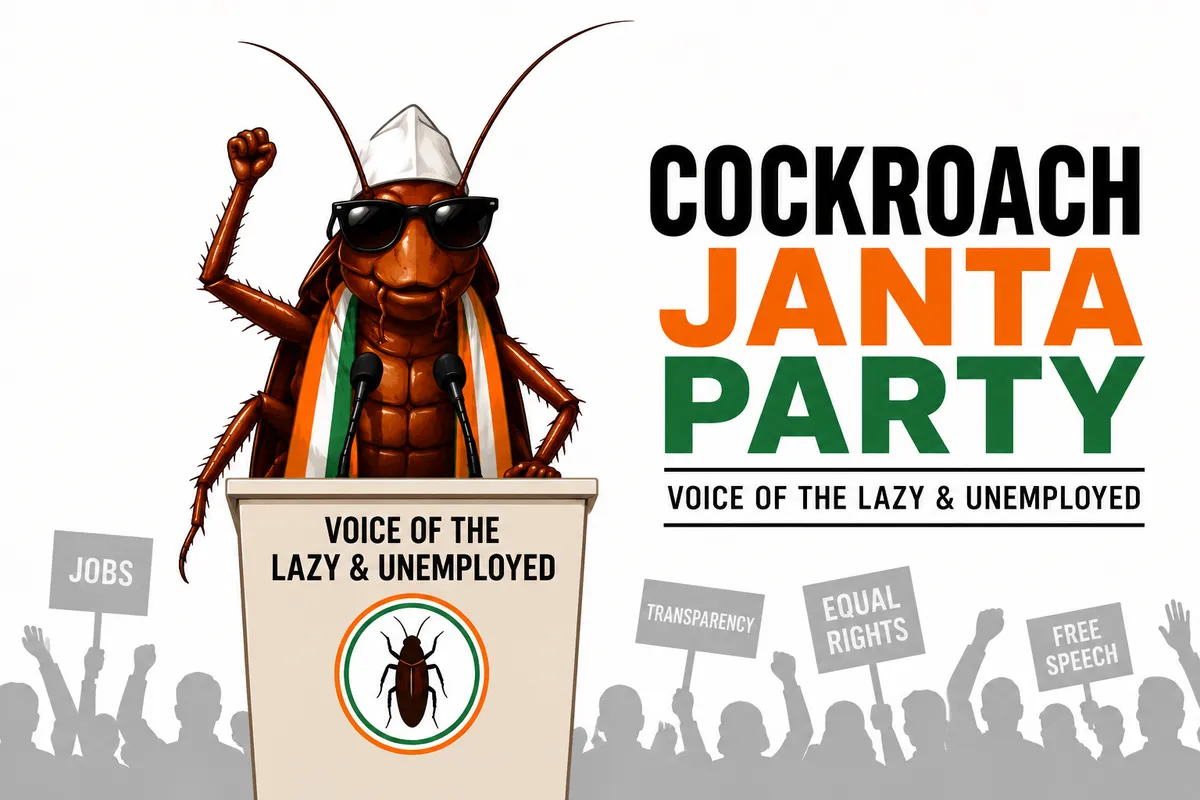
A satirical online movement called the Cockroach Janta Party has taken Indian social media by storm — and it all started with a few words from the country's top judge.
The controversy traces back to oral observations made during a Supreme Court hearing, in which remarks attributed to Chief Justice of India Surya Kant were widely interpreted online as comparing unemployed youth and activists to "cockroaches" and "parasites." The remarks quickly spread across social media platforms and news outlets. Opposition leaders, lawyers, activists, and everyday users piled on, and the backlash was swift.
Internet users, however, didn't just complain — they got creative. The "Cockroach Janta Party" was born almost immediately, repackaging the insult as a badge of protest. The website pitches itself as a mock political party for young people routinely dismissed as "lazy," "chronically online," or worse, complete with parody branding, a mock constitution, membership forms, and a manifesto. Its tagline: "Voice of the Lazy & Unemployed." A disclaimer at the bottom reads simply, "The rest is satire."
That manifesto punches at real targets — pushing for greater RTI transparency, opposing anonymous political funding, and advocating for democratic participation and free speech. Within days, the movement reportedly amassed tens of thousands of online supporters, with hashtags and memes flooding Instagram, Reddit, and X.
CJI Surya Kant later clarified that the remarks had been taken out of context, saying they referred to people misusing professional credentials — not India's youth, whom he called "pillars of a developed India." Media coverage, he added, had distorted his original observations.
Whether or not that clarification landed, the movement it sparked shows no signs of fading. India has a long tradition of political satire — from groups like Aisi Taisi Democracy to formats borrowed from global parody culture — but the Cockroach Janta Party represents something newer: meme-native activism, where frustration over unemployment and political exclusion finds its outlet not in rallies, but in viral jokes and fake party websites.
The group holds no official registration as a political party. But then again, that may not be the point.