KYIV — The explosions began just after one in the morning and did not stop for hours.
Wave after wave of Russian missiles and drones tore through Kyiv in the early hours of Sunday, shaking buildings from their foundations, triggering fires across multiple neighborhoods, and sending residents scrambling into subway stations clutching children and blankets. By the time daylight broke over the battered Ukrainian capital, at least four people were dead, 87 had been wounded, and damage had been recorded across every district of the city.
It was, by most accounts, one of the most intense aerial assaults Kyiv has endured in the four-year war.
Ukraine's Air Force reported that Russia launched 90 missiles and 600 drones overnight — a barrage that lasted several hours and stretched emergency services well past sunrise. Air defense forces intercepted most of the drones and more than half of the missiles, though the sheer scale of the assault meant destruction was widespread regardless.
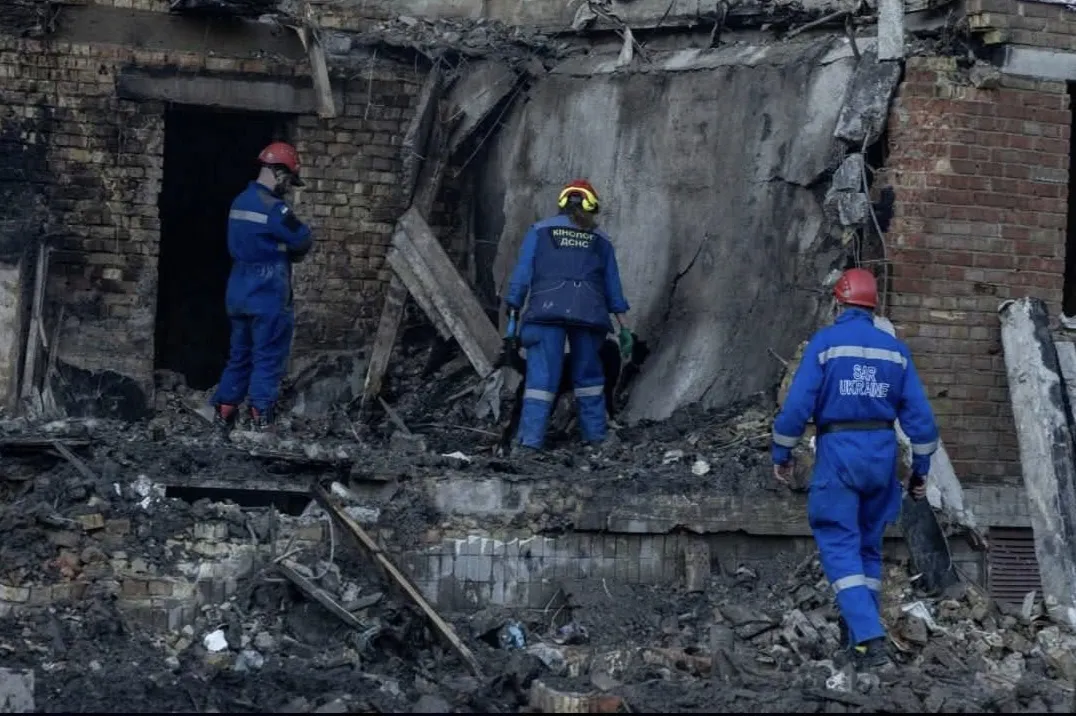
Two women, aged 44 and 86, were killed in Kyiv city itself. Two more people died in communities across the surrounding Kyiv region. Rescue workers, search dogs, and firefighters were deployed across multiple districts through the night and into Sunday afternoon as teams cleared rubble to reach the injured and missing.
In the Shevchenko district, a five-story residential building took a direct hit, sparking a fire and killing one of the victims. A school in the same district was struck while civilians were sheltering inside, Mayor Vitalii Klitschko confirmed. Supermarkets, warehouses, and cultural institutions across the city also sustained damage — the worst destruction to Kyiv's cultural sites since Russia's 2022 invasion, according to Ukraine's culture minister.
Klitschko said there was damage in "every district of the city."
Among the most alarming developments of the night was Russia's use of the Oreshnik — a hypersonic ballistic missile capable of carrying nuclear or conventional warheads. Zelenskyy said the weapon struck Bila Tserkva, a city roughly 50 miles south of Kyiv, marking the third confirmed use of the Oreshnik since the full-scale war began. Russia's Defense Ministry acknowledged the deployment in a statement, saying its forces used the missile alongside other weapons to strike what it described as military command and control facilities and air bases. Ukrainian officials rejected that characterization, saying civilian areas bore the brunt of the assault.
The strikes came hours after Zelenskyy had already warned Ukrainians that a major attack involving the Oreshnik was imminent, citing intelligence from European and American partners.
Zelenskyy described the assault as an act of terror against civilians and called on international partners to apply greater pressure on Moscow. European Commission President Ursula von der Leyen announced that the European Union would send additional support to help Ukraine strengthen its air defense systems, saying the attack demonstrated the Kremlin's "brutality and disregard for both human life and peace negotiations."
Russian strikes also damaged the residence of Albania's ambassador to Ukraine. Albania's Foreign Minister said the ambassador's life had been placed at serious risk.
The attack followed days of escalating threats from Moscow. Ukrainian and American officials had warned of a possible major strike on the capital after Russia publicly threatened to respond to Ukrainian attacks in Russian-controlled eastern territory. Kyiv denied that framing entirely, insisting the assault had no military logic and was directed squarely at civilian life.
Rescue operations stretched well into Sunday afternoon. Emergency officials cautioned that the casualty toll could rise further as teams continued to clear debris from dozens of damaged sites across the capital.
For residents of Kyiv, Sunday began not with the city holiday it was meant to be — Kyiv Day, celebrated each year on the last Sunday of May — but with smoke on the skyline and sirens that had not yet fallen quiet.